 Image Credit:Hubble Heritage Team, C. Robert O'Dell (Rice University), Thomas P. Ray (Dublin Institute for Advanced Study), and David Corcoran (University of Limerick).
1) The Reflection Nebula in Orion: Hubble's Wide Field and Planetary Camera 2 was used to obtain this image of NGC 1999, about 1,500 light-years from Earth, it is a classic example of example of a reflection nebula. The nebula does not emit any visible light of its own, but is lit from an embedded source, which illuminates its dust.

Photo Credit: Hubble Heritage Team (STScI / AURA), Y. Chu (UIUC) et al., NASA
2) Cosmic Blast: Scattered debris from a cosmic explosion These glowing filaments of shocked gas span about 30 light-years.
 Image credit: NASA/JPL-Caltech/Harvard-Smithsonian CfA
3) A delicate flower in the Ring Nebula: Located about 2,000 light years from Earth in the constellation Lyra, this planetary nebula looks surprisingly similar to the intricate petals of a camellia blossom.
 Image Credit: Credit: NASA; ESA; Hans Van Winckel (Catholic University of Leuven, Belgium); and Martin Cohen (University of California, Berkeley).
4) Stairway to Heaven: This image, taken with NASA's Hubble Space Telescope, shows amazing details of one of the most unusual nebulae known in the galaxy. HD 44179 is more commonly called the "Red Rectangle" because of its unique shape and colour as seen with ground-based telescopes.
 Image Credit: NASA/JPL-Caltech/University of Wisconsin.
5) The Black Widow Nebula: In this image, taken by the Spitzer Space Telescope, two opposing bubbles are being formed in opposite directions by the powerful outflows from massive groups of forming stars. The baby stars can be seen as specks of yellow where the two bubbles overlap. When individual stars form from molecular clouds of gas and dust, they produce intense radiation and very strong particle winds. Both the radiation and the stellar winds blow the dust outward from the star creating a cavity or bubble.

Image Credit: NASA, ESA and The Hubble Heritage Team (STScI/AURA).
6) The Boomerang Nebula: This reflecting cloud of dust and gas has two nearly symmetric lobes (or cones) of matter that are being ejected from a central star. Over the last 1,500 years, nearly one and a half times the mass of our Sun has been lost by the central star of the Boomerang Nebula in an ejection process known as a bipolar outflow. The Boomerang Nebula is about 5,000 light-years from Earth. Measurements show the nebula has a temperature of only one degree Kelvin above absolute zero (nearly -460 degrees Fahrenheit).
 Image Credit: NASA/JPL-Caltech/University of Arizona.
7) Comets Kicking up Dust in Helix Nebula: NASA's Spitzer Space Telescope, shows this infrared image of the Helix nebula, The nebula, located about 700 light-years away in the constellation Aquarius, belongs to a class of objects called planetary nebulae. Infrared light from the outer gaseous layers is represented in blues and greens. The white dwarf is visible as a tiny white dot in the center of the picture. The red color in the middle of the eye denotes the final layers of gas blown out when the star died. This dust, discovered by Spitzer's infrared heat-seeking vision, was most likely kicked up by comets that survived the death of their star. The Helix nebula is one of only a few dead-star systems in which evidence for comet survivors has been found.
 Image Credit: NASA/Andrew Fruchter (STScI)
8) The Eskimo Nebula: The Hubble Space Telescope imaged the Eskimo Nebula, which displays gas clouds so complex they are not yet fully understood. The Eskimo Nebula is a planetary nebula, and the gas seen above composed the outer layers of a sun-like star only 10,000 years ago. The inner filaments visible above are being ejected by strong wind of particles from the central star. The outer disk contains unusual light-year long orange filaments.

Image Credit: NASA, JPL-Caltech, J. Rho (SSC/Caltech)
9) The Trifid Nebula: The Trifid Nebula, M20, is found in the constellation of Sagittarius. This false-color view taken by the Spitzer Space Telescope cuts through the gas to reveals filaments of luminous gas and newborn stars that otherwise lie hidden in the natal dust.
 Image Credit: NASA
10) The Stingray Nebula: The Hubble Space Telescope captured this image of the Stingray Nebula, the youngest known planetary nebula, it lies 18,000 light-years away. The nebula is as large as 130 solar systems. The colors shown are actual colors emitted by nitrogen (red), oxygen (green) and hydrogen (blue).
More Information.
Spitzer Space Telescope.
NASA
JPL Homepage
Nebula Article In Wikipedia
 Pearl Tobacco cover from 1871.
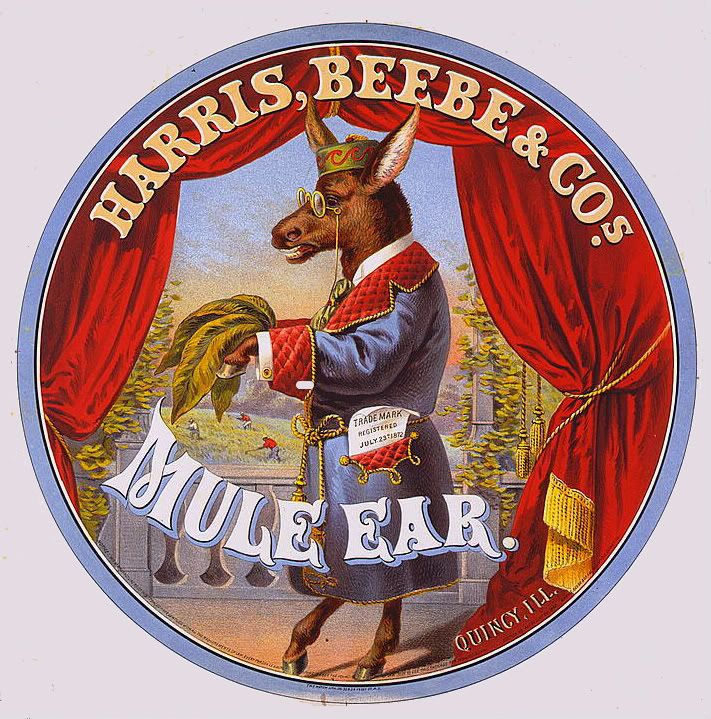 An 1868 Mule ear cover for Harris, Beebe & Cos., Quincy, Ill.
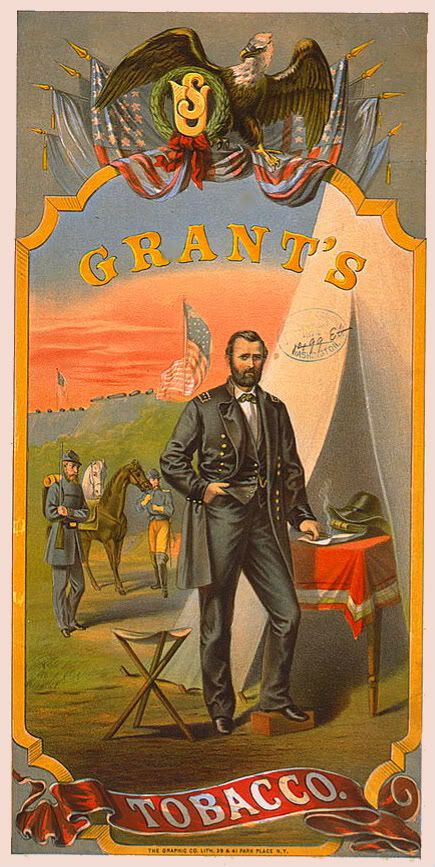 An early endorsement for tobacco from general Ulysses S Grant, cover for a box of Grants Tobacco 1874.
 Cover for a box of Ariel Tobacco 1869.
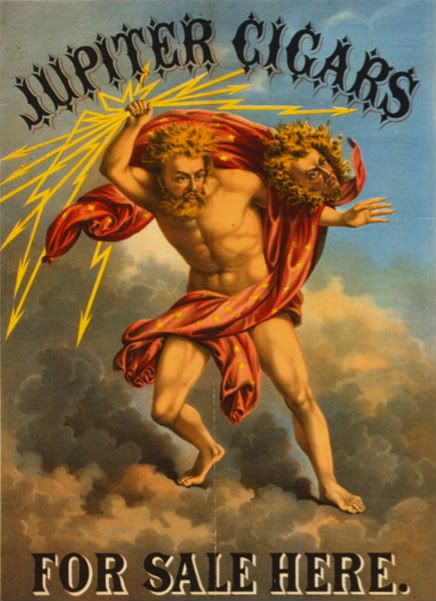 1868 poster advertising "Jupiter cigars for sale here."
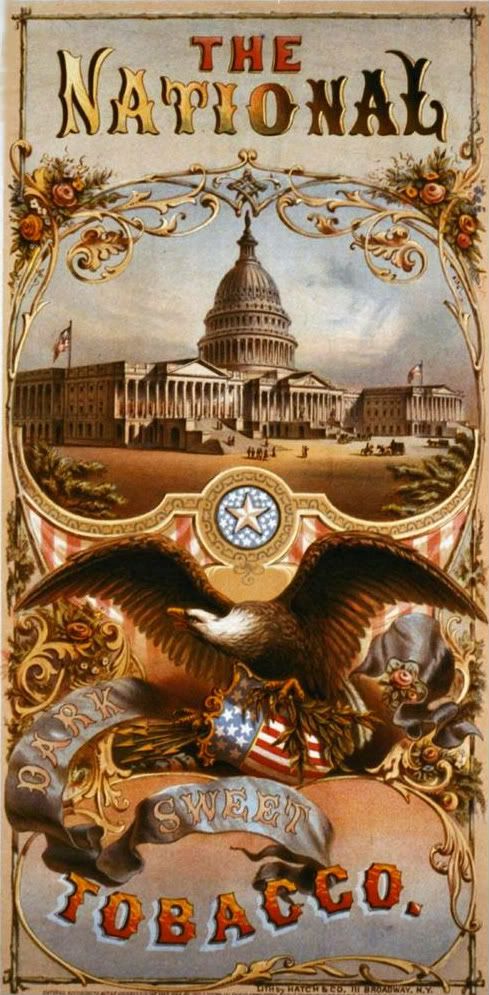 Cover of a box of The National Tobacco 1868.
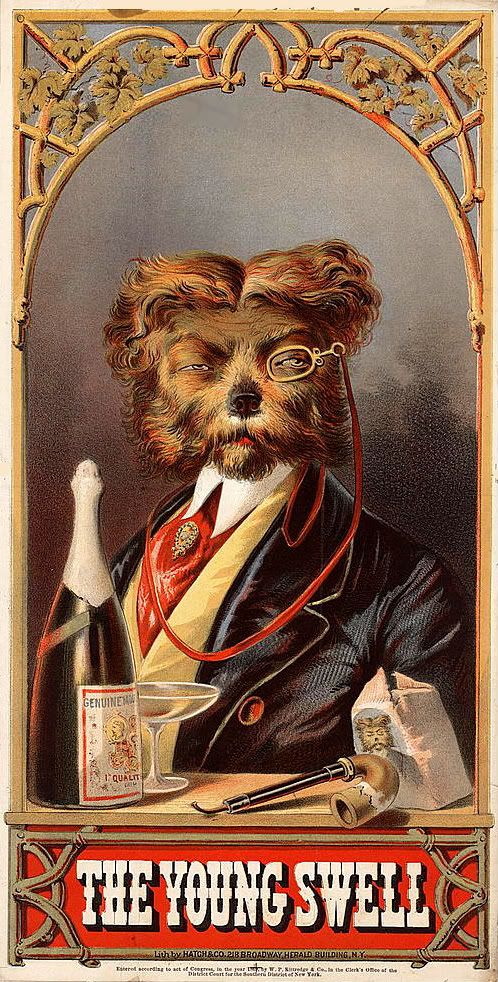 Print of a tobacco label showing a head-and-shoulders portrait of a dog dressed as a man, facing forwards, wearing monocle, shown with a bottle of champagne, a pipe, and a bag of pipe tobacco in the foreground, Captioned as The Young Swell.
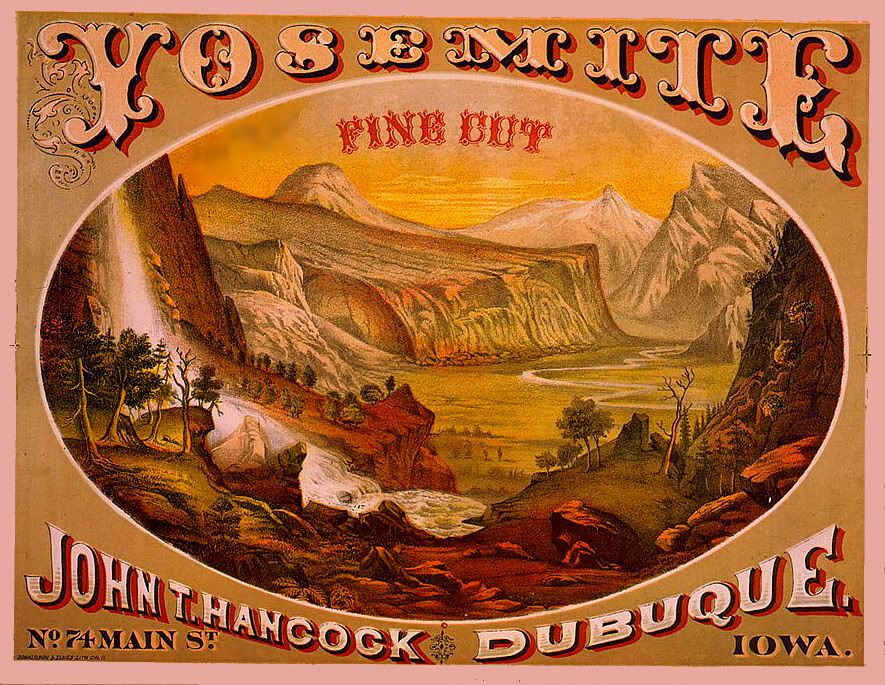 Yosemite Tobacco, Fine Cut, produced by John T. Hancock, Dubuque, Iowa 1872.
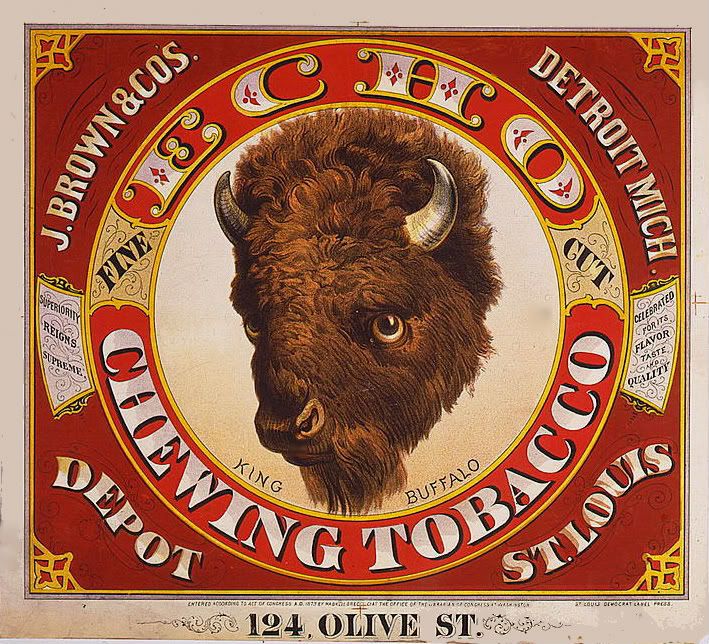 Tobacco label for Echo Chewing Tobacco by J. Brown & Co. of Detroit, Michigan 1873.
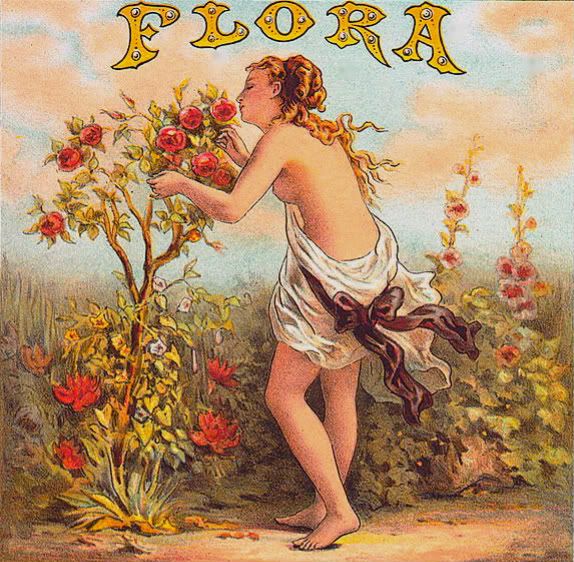 Cover for Flora brand 1873.
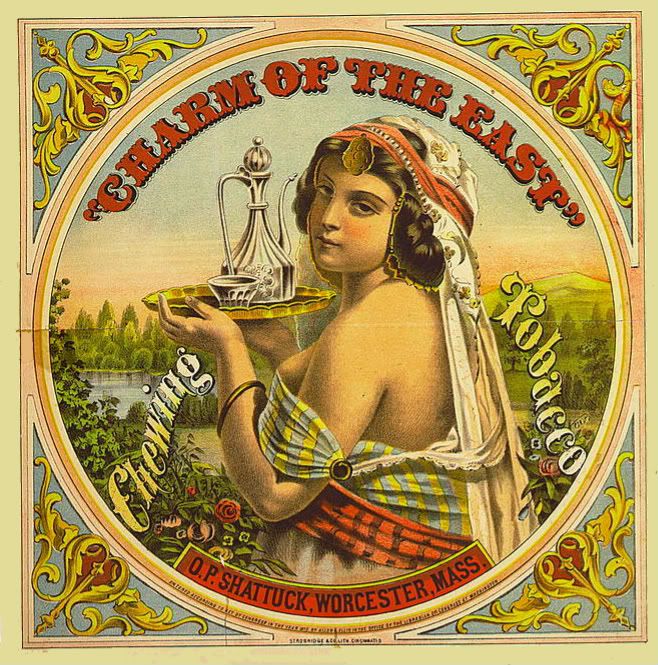 Charm of the East Chewing tobacco cover, produced by O.P. Shattuck, Worcester, Mass,1872.
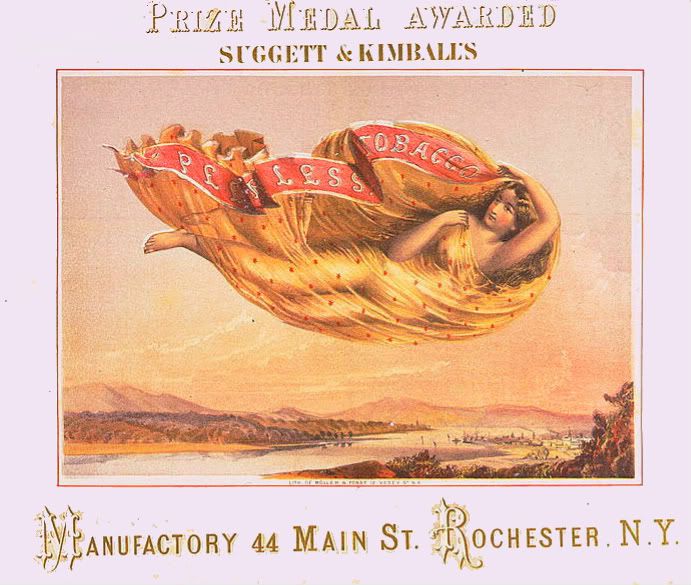 Suggett & Kimball's peerless tobacco, 1864.
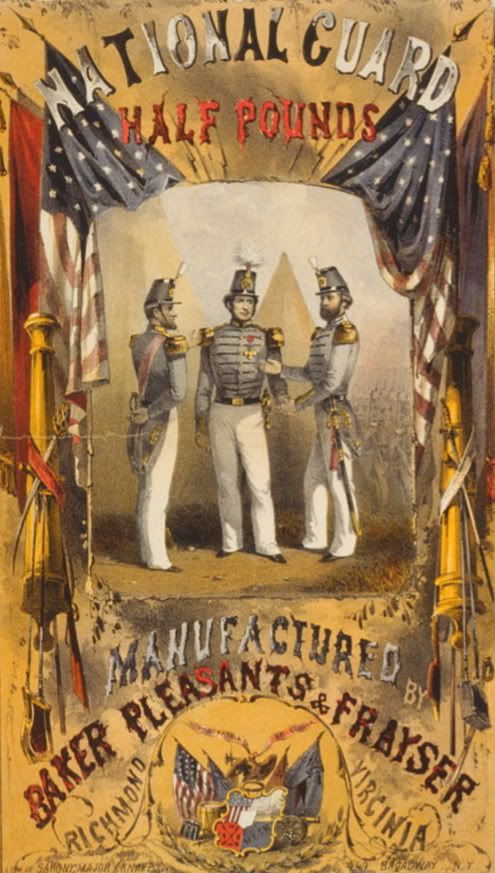 Tobacco label for national Guard Brand Tobacco, label shows three officers of the New York State Militia 1857.
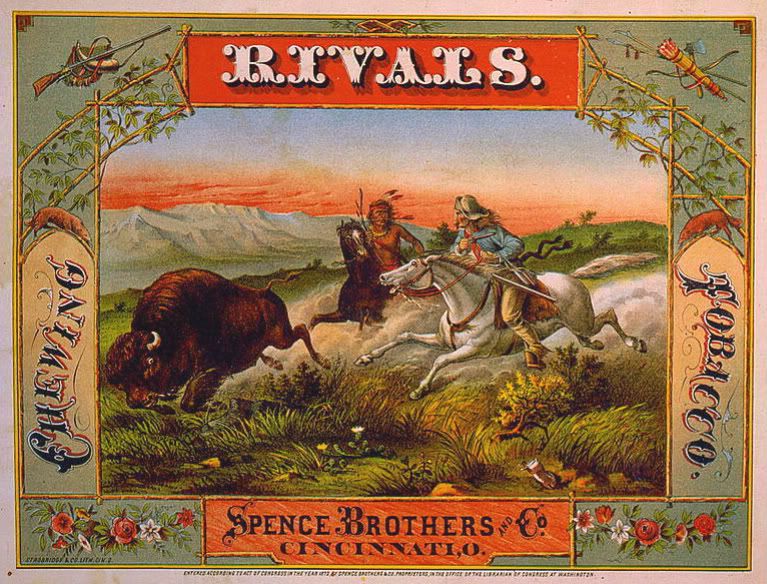 Rivals brand Chewing tobacco by the Spence Brothers and Co., Cincinnati, O. 1872.
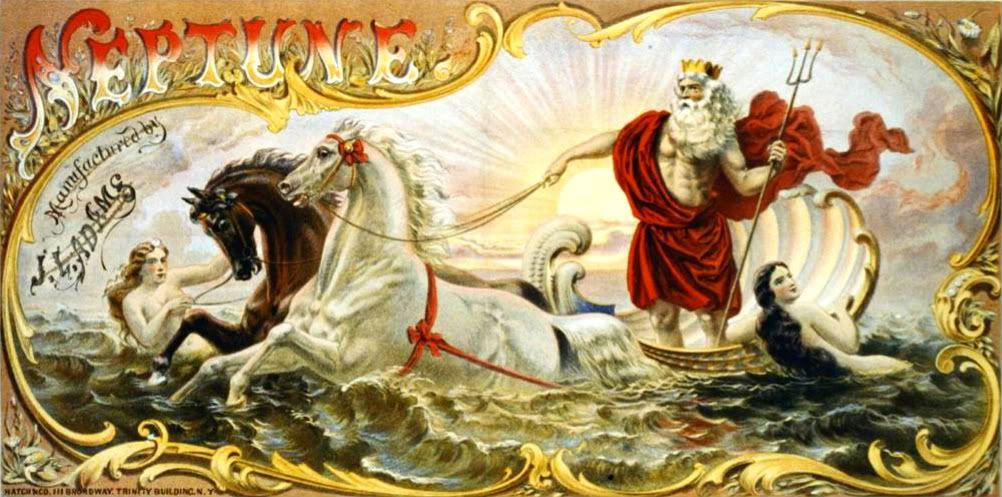 Neptune brand box cover, Manufactured by J.L. Adams 1866.
 Tobacco label for Ocean queen box cover 1875.
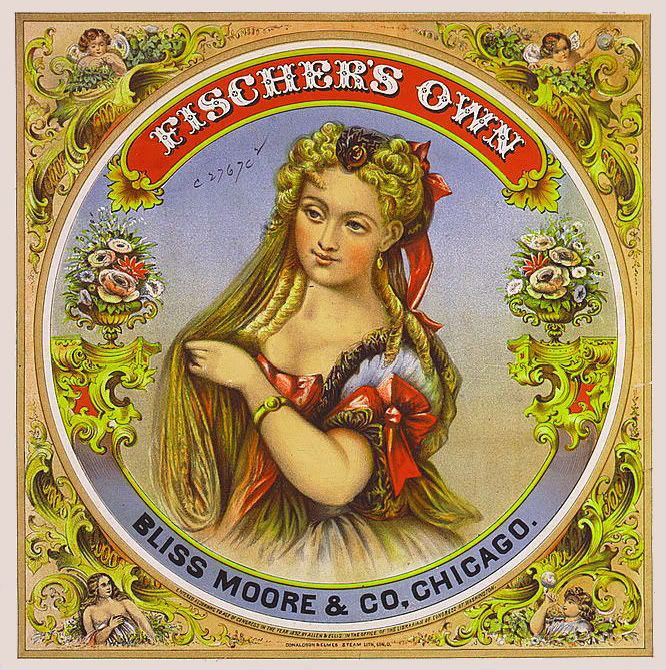 Fischer's own, produced by Bliss Moore & Co., Chicago 1872.
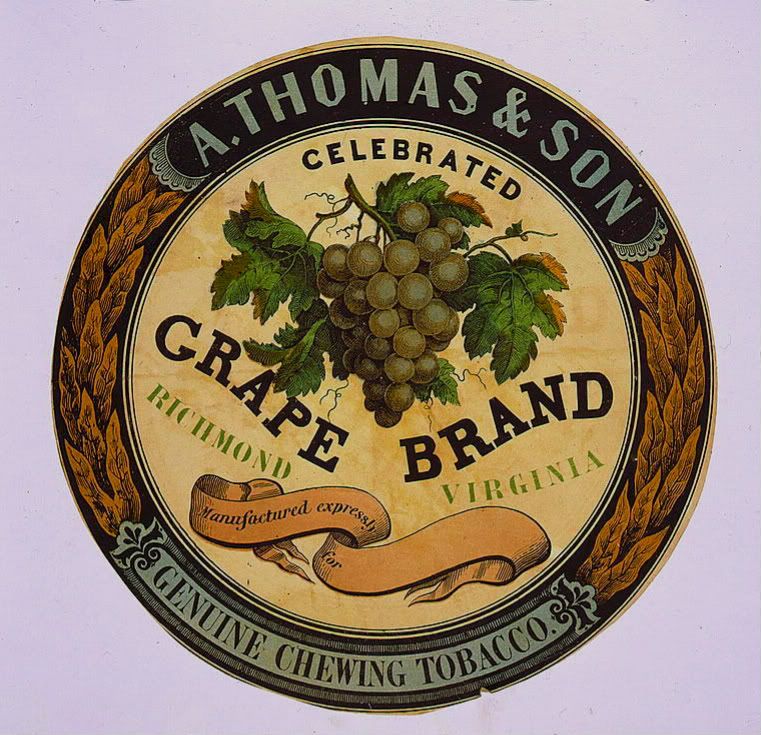 Box cover registered by A Thomas & sons sometime between 1860 and 1880.
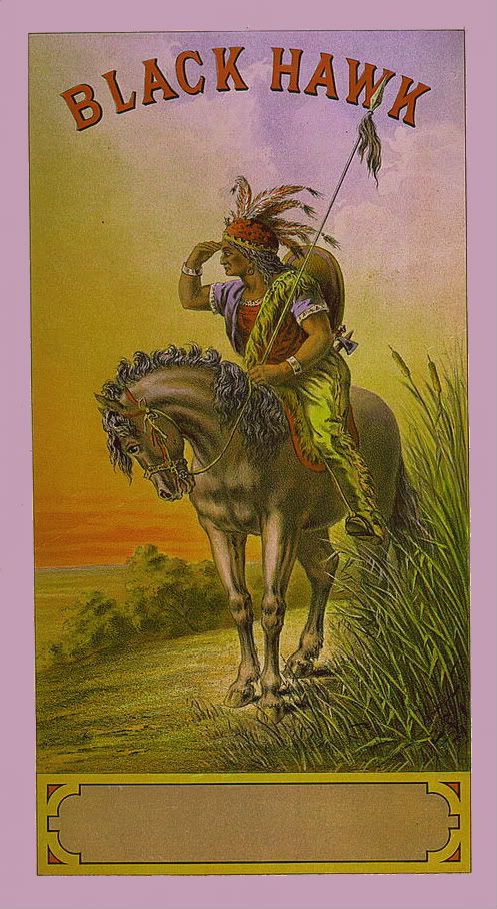 Tobacco package label for Black Hawk Brand. Label depicting "Black Hawk", on horse, scanning the horizon. 1870's.








 Posts


