A Collection Of American First World War Posters.

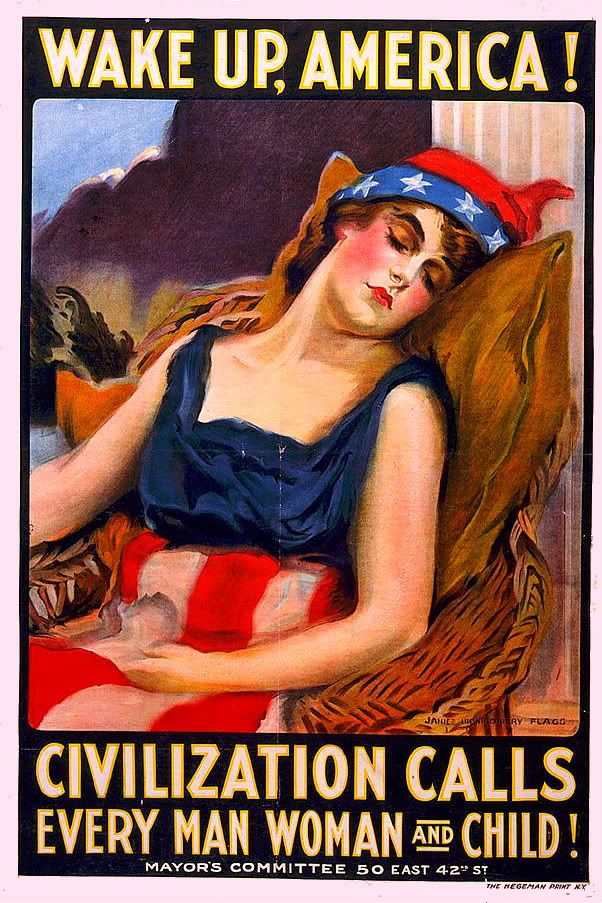
Poster for the Mayors Committee by James Montgomery Flagg, 1917.


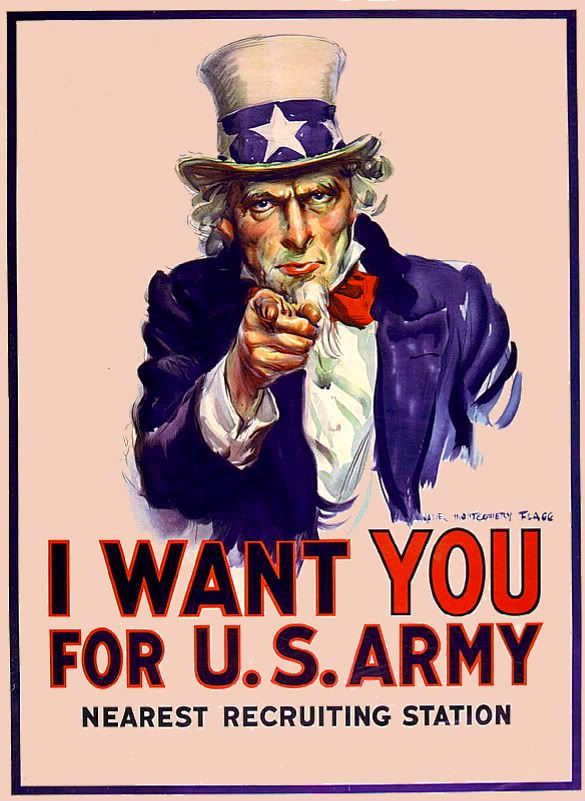
"I want you for U.S. Army nearest recruiting station" by James Montgomery Flagg, 1917.

Poster depicting a woman, a passenger from the Lusitania, submerged in water while cradling an infant in her arms. By Fred Spear, 1915.

Unknown creator sometime between 1914 and 1918.

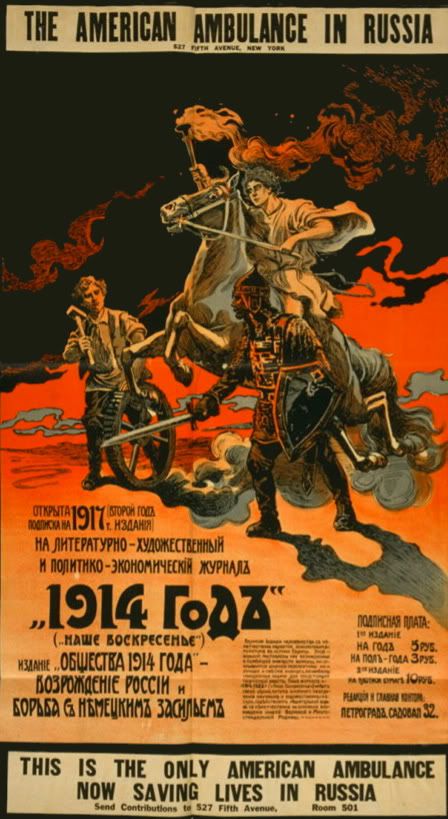
Poster publicising the World War One American Ambulance service, The Willard and Dorothy Straight Collection, 1914.

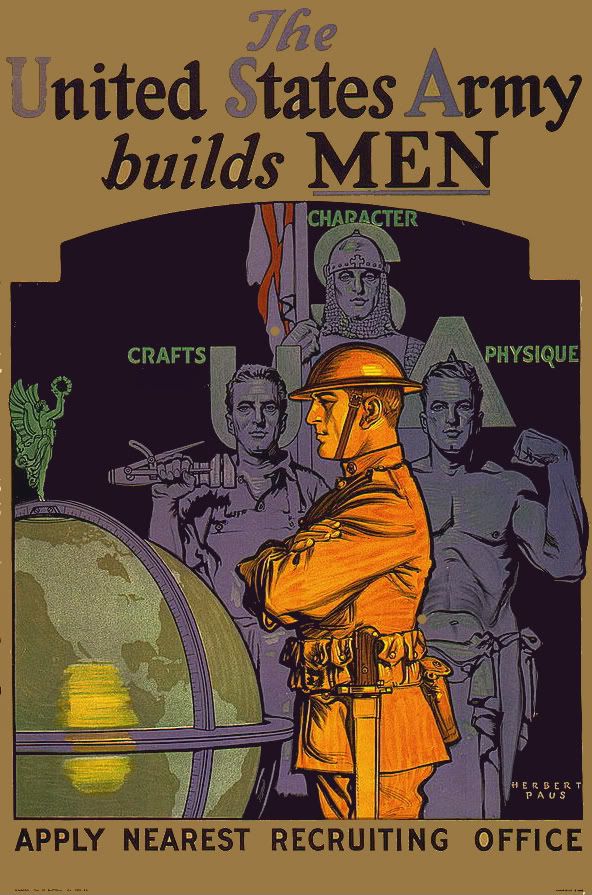
US Army Recruiting poster by Herbert Paus, 1919.


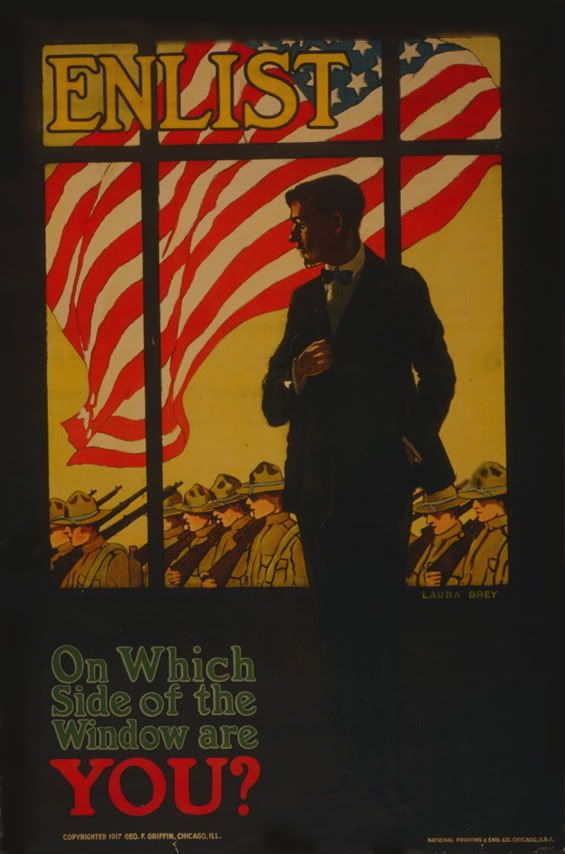
Enlistment poster by Laura Brey, 1917.

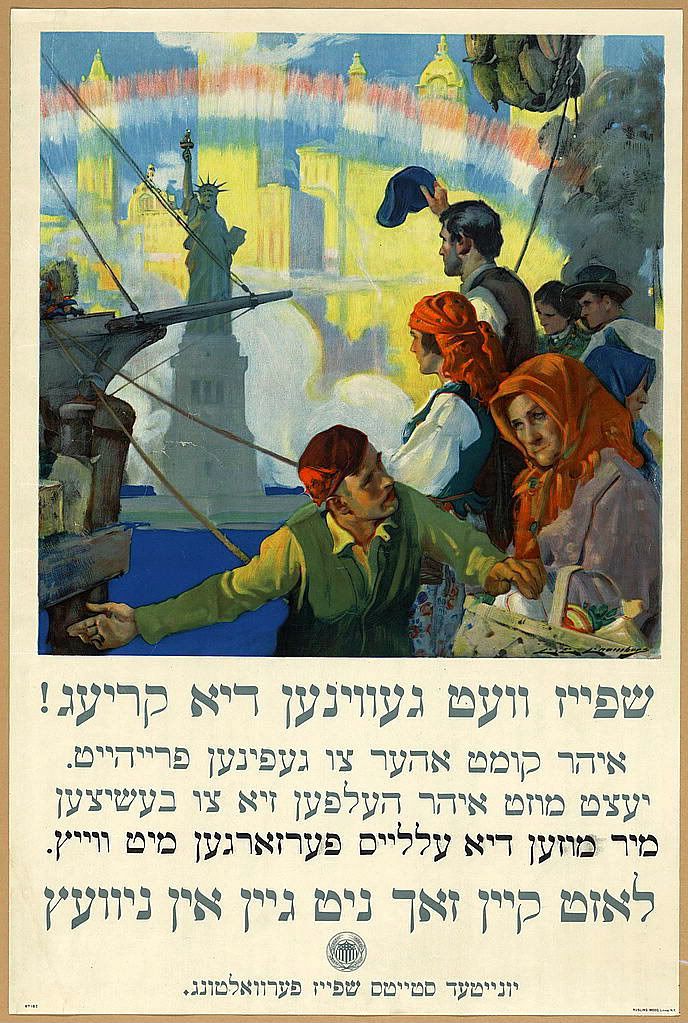
Poster for new immigrants reading "Food will win the war - You came here seeking freedom, now you must help to preserve it - Wheat is needed for the allies - waste nothing". by C. E. Chambers, 1917.

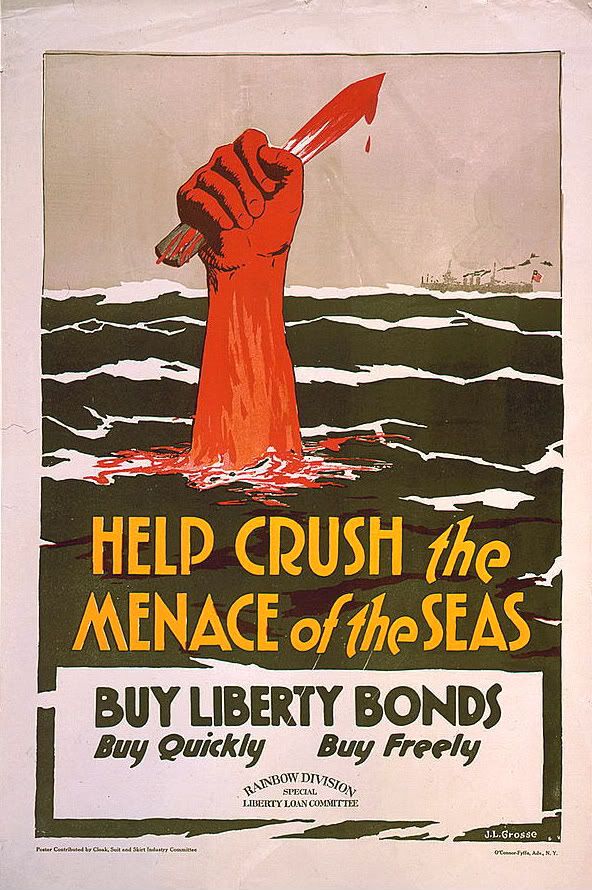
Liberty Bonds Poster by J.L. Grosse, 1918.

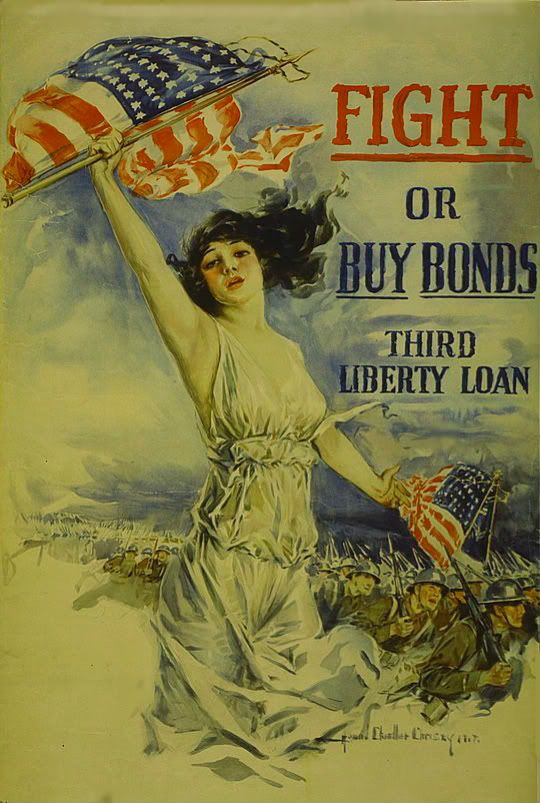
Fight or Buy by Howard Chandler Christy, 1917.


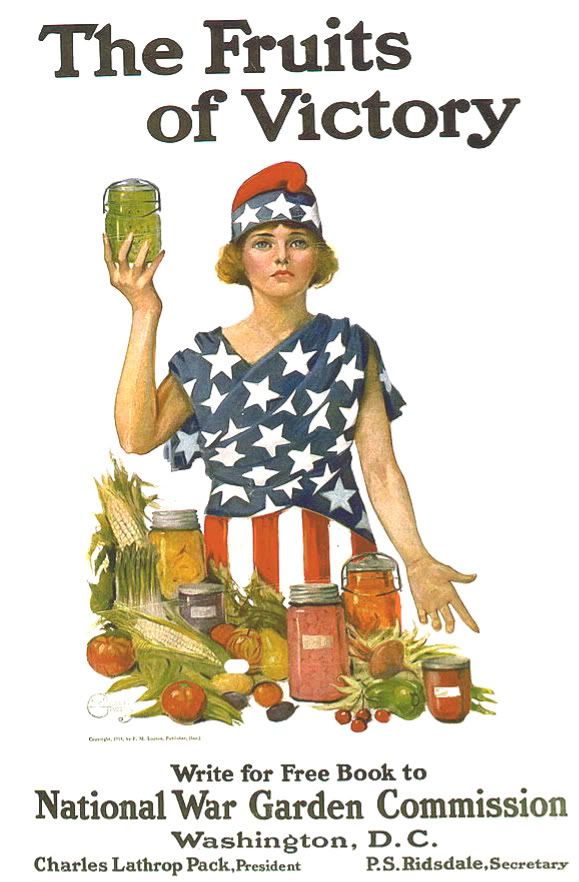
National War Garden poster by leonobel jacobs, 1918.

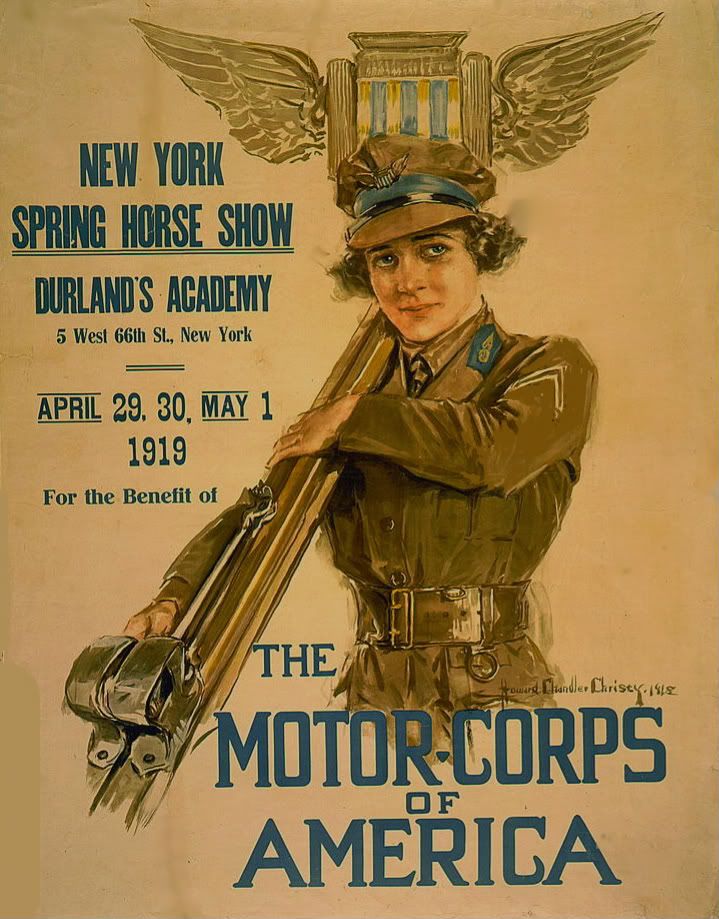
Motor Corps Of America by Howard Chandler Christy, 1918.

Enlistment poster "Go over the top with U.S. Marines" by John A. Coughlin, 1917.


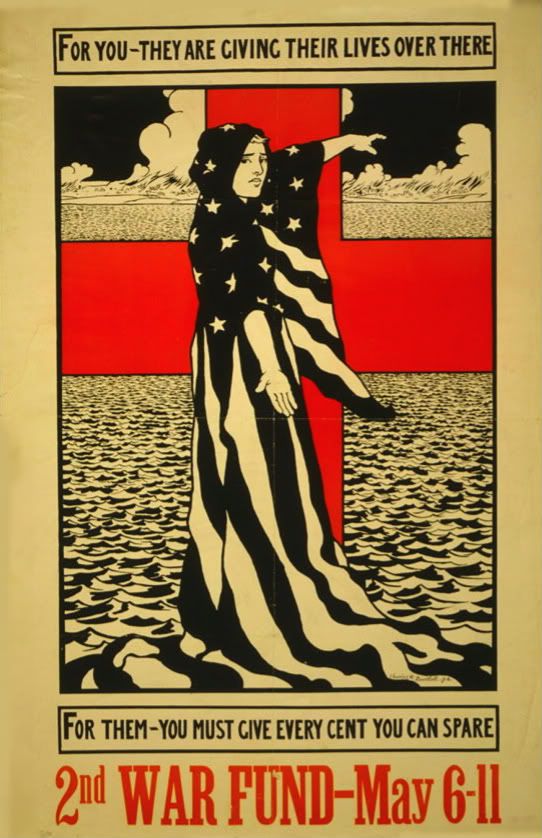
Second War Fund poster by Charles W. Bartlett, 1918.

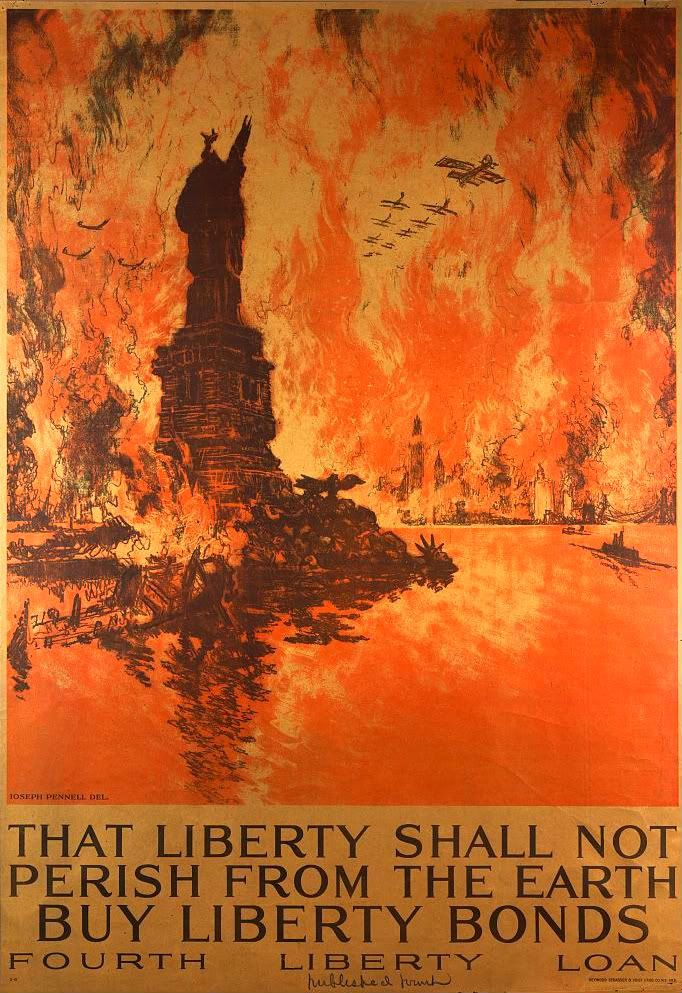
Fourth Liberty Bonds Loan poster by Joseph Pennell 1918.


More Information.

10 Zoo Posters From The Works Progress Administration.

The Works Progress Administration was established in 1935 by Franklin Delano Roosevelt as part of the New Deal programme. Until its closure, during the war boom, in 1943, the agency was the largest employer set up under the new deal programme. The Works Progress Administration provided jobs many jobs in the arts and media to people who were under financial hardship, setting conditions of 30 hours a week and pay set at the average local level, it offered almost unrivaled opportunities for many workers, indeed some projects even stipulated adult education as part of their contracts.
Below is a collection of posters produced to advertise or promote local zoos. The works were simple block or screen prints, produced in local areas, by local people.

Work Projects Administration Poster Collection 1938: Visit the Brookfield Zoo by the "L", Gregg Arlington.

NYC : Federal Art Project: Who's who in the zoo Illustrated natural history, prepared by the WPA Federal Writers Project, Sidney Jacobson 1937.

Pennsylvania : Federal Art Project,Work Projects Administration Poster Collection produced between 1936 and 1941.

Philadelphia Work Projects Administration Poster Collection, by Hugh Stevenson 1937.

Pennsylvania : WPA Federal Art Project, Louise Welsh 1937.

W.P.A Federal Art Project, Mildred Waltrip 1938.

Work Projects Administration Federal Arts Programme, Designed by Carken,1936.

Visit the Brookfield Zoo free Thursday, Saturday, Sunday. Poster by Carken 1936.


Pennsylvania : Federal Art Project, W.P.A., produced between 1936 and 1941

Pennsylvania : WPA Federal Art Project, designed by Hugh Stevenson, 1937

More Information.

The Works Progress Administration.


Scenes From The Bureau of Reclamation.

Photograph from the U.S. Bureau of Reclamation showing a casing section of pipe suspended by cable, as it is moved into position by a crane during construction of the Grand Coulee Dam, Washington.

The U.S. Bureau of Reclamation, an agency of the Department of the Interior, is one of the main water management agencies of the United States government. Set up after Congress passed the Reclamation Act of 1902, its aim was to reclaim the desert areas of the seventeen western states for settlement through the development of irrigated agriculture.

Photograph by F.B. Pomeroy: Grand Coulee Dam, Columbia Basin Reclamation Project; Looking down the face of the dam from the roadway on top. Men are riding a skip to the area to be repaired. September 1942.

The United States Reclamation Service, as it was then named, studied and applied potential water development projects in the western states. Between 1902 and 1907 the bureau of set up and managed around 30 projects in western states area. By 1923 however, increasing unrest among the settlers and budgetary problems were becoming increasing problematic for the fledgling agency. As it became more apparent that reorganisation of the service was needed, its name was changed from the United States Reclamation Service, to The Bureau Of Reclamation (reclamation meaning irrigation) and it was moved from the U.S.G.S and placed under the management of The Department Of The Interior.

Rows 27 to 29 of the Shasta Dam on downstream face, as seen from left abutment.1935-40.

This started the boom years for the Bureau of Reclamation, under the New Deal programs, the agency was reorganised. As the programmes managed by the bureau developed, it became clear that reclamation dams and reservoirs could be further evolved and developed to meet other parallel needs, such as flood control, municipal water supply, and hydroelectric power generation.


The dam gets a facial: Worker suspended by ropes "removing spilled concrete, water stains, grout streaks, and other blemishes" on the downstream face of the Friant Dam, California 1936-46.

Central Valley Reclamation Project, Calif. Pier 11, spillway section of the Keswick Dam, as seen from a point downstream. September 1942.

The construction of the Hoover Dam under The Central Valley Project in California, and the Grand coulee dam under the Columbia Basin Project, perhaps marked the high point for the large scale construction projects undertaken by the bureau.

View of Hiwassee Dam and powerhouse.1936-1940.


Photograph by: F.B. Pomeroy .U.S. Bureau of Reclamation: A steel worker working on a section of the Grand Coulee Dam east powerhouse, June 1942.

During World War II, many of the large scale projects were scaled back, but between 1941–1947 labour provided by the Civilian Public Service allowed the bureau to restart many of the projects interrupted for the war effort.

Tennessee Valley Authority: Workmen in the dam powerhouse installing a generator, Norris Dam, Tennessee. 1935-40.

Three construction workers putting a coat of paint on a slanted wall of riveted-steel plates on the Hoover Dam spillway between 1936 and 1946

By the 1960's the construction phase was beginning to slow as many of the large projects conceived to help "tame" the rivers and lakes of the west were completed, indeed by the 1980's the bureau was again undertaking major reorganization with a new redefined official mission to "manage, develop, and protect water and related resources in an environmentally and economically sound manner in the interest of the American public".

Photograph by Barbra Wright: Exterior wall of dam from below, with flag pole and American flag 1941.


Columbia Basin Project, Grand Coulee Dam. Photograph showing construction on the turbine pit at the Grand Coulee Dam, Washington. December 1942.

This was the final switch from construction, to maintenance and management of the water systems in the western states. The Bureau of Reclamation now operates about 180 projects in the 17 western states. These projects provide agricultural, household, and industrial water to about one-third of the population of the American West. The Bureau Of Reclamation provides water to about 9,120,000 acres (37,000 km²) of farmland, and has constructed more than 600 dams and reservoirs including the Hoover and Coulee dams. It runs 58 hydroelectric power plants and produces enough hydro electricity to serve 6 million homes.

Central Valley Reclamation Project, Kennett Division: Shasta Dam cable way head tower California 1940.

Three construction workers, suspended by ropes, with pneumatic hammers cutting into a mountain, during construction of the Grand Coulee Dam, Columbia River, Washington 1936- 1946.

Boulder Dam, (i.e. Hoover Dam): Placing concrete in the sidewall of the Nevada spillway. Note the manner in which the panels are staggered, June 1933. (Early plans called for the dam to be built in Boulder Canyon, so the project was known as the Boulder Canyon Project. The dam site was eventually moved downstream eight miles to Black Canyon, but the project name remained)


The Parker Dam power project, Arizona and California. View of Parker Dam from the California side 1941.

The Grand Coulee Dam, Columbia Basin Reclamation Project: The east face of block 31 with a portion of the deep crevice shown in the foreground showing the high trestle.


The All American Canal Project, Imperial Dam, channels 2-4, California and Arizona. February 1939.


Chickamauga Dam and powerhouse: View of Chickamauga spillway floodlighted at night, from visitors' overlook terrace at powerhouse. 1933 and 1945.

More Information.


All the photographs in this collection are courtesy of the Office of war information and Bureau Of Reclamation collection at the Library Of Congress.
8 Cool Clouds.

Image Credit: Image Science & Analysis Laboratory, Johnson Space Center. I.S.S crew 16.

Anvil Cloud With Cumulus Tower: This image was captured when the International Space Station was located over western Africa, near the Senegal-Mali border. The photograph shows an anvil cloud with numerous smaller cumulonimbus towers rising around it.


Image courtesy: The Image Science & Analysis Laboratory, NASA Johnson Space Center.

The Eye Of Hurricane Isabel(2003), Atlantic Ocean: Astronaut Ed Lu took this oblique photo of Hurricane Isabel from the International Space Station on September 15, 2003. At the time, Isabel was heading for the east coast of the US and had strengthened to a Category 5 hurricane, with winds estimated at 160 mph.

Image Credit: Jacques Descloitres, MODIS Rapid Response Team at NASA GSFC.

Extreme Cold in Canada: In this satellite image taken over The Gulf of St. Lawrence, Cold, dry arctic air is swept down over Canada, as the cold air moves out over the Atlantic Ocean it meets the warmer, moister air over the Atlantic, and clouds are formed. In this false-colour image visible light is assigned to the red spectrum while the ice appears dark red and water is black. The ice in the clouds tint them a light orange, making the sky appear to be on fire.

Image Credit: NASA, The USGS, EROS Data Center Satellite Systems.

Aleutian Clouds: These cloud formations were seen over the western Aleutian Islands. Their colour variations are due to differences in temperature and in the size of water droplets that make up the clouds.

Image Credit: Jeff Schmaltz, NASA

Wake Shaped clouds, Amsterdam Island, Indian Ocean: The cloud patterns seen in this image resemble the wake left by a ship. The pattern is not coincidental. Winds act in the same way as a fluid, when it encounters an obstacle, it must move around it, in doing so it leaves behind a wake or a visible wave pattern. In this case, as the wind hit Amsterdam Island it was forced to rise up over the island, as it did so it cooled forming clouds. Once it was over the island, the air sank into the trough, the air warmed, and clouds did not form. This pattern repeated itself, with clouds appearing at the peak of every wave, thus creating the banded effect.

Image Credit: NASA

Fireworks On The U.S. East Coast: This photo of a trimethylaluminum cloud was taken over the Poker Flat Research Range, Alaska.
In an experiment to understand "space weather" or the interaction of the solar wind with the Earth's magnetic field and atmosphere, NASA launched a series of rockets into the ionosphere at altitudes of between 43 and 96 miles (69 to 154 kilometers), which produced long clouds of a chemical called trimethylaluminum. The test area encompassed the mid-Atlantic region and portions of the northeastern and southeastern United States.

Image Credit: The SeaWiFS Project, NASA/Goddard Space Flight Center, and ORBIMAGE.

Great Lake Effects: The effect is produced in the winter when cold winds move across long expanses of warmer lake water, providing energy and picking up water vapour which freezes and is deposited on the lee side shores as snow.

Image Credit: Jeff Schmaltz, MODIS Rapid Response Team, NASA/GSFC.

Clouds In The Eastern Pacific: Captured by the Moderate Resolution Imaging Spectroradiometer (MODIS), on the Terra satellite, on December 18, 2002, this unusual cloud formation over the eastern Pacific Ocean shows a cloud chain locked together like vertebra.


Melted Red White and Blue.

This photograph by David Finn, Taken in New York on September 11 2001, shows melted red, white, and blue candle wax left on a sidewalk.

Image Courtesy : David Finn 2001, Library Of Congress.

A Collection Of German first World War Posters.

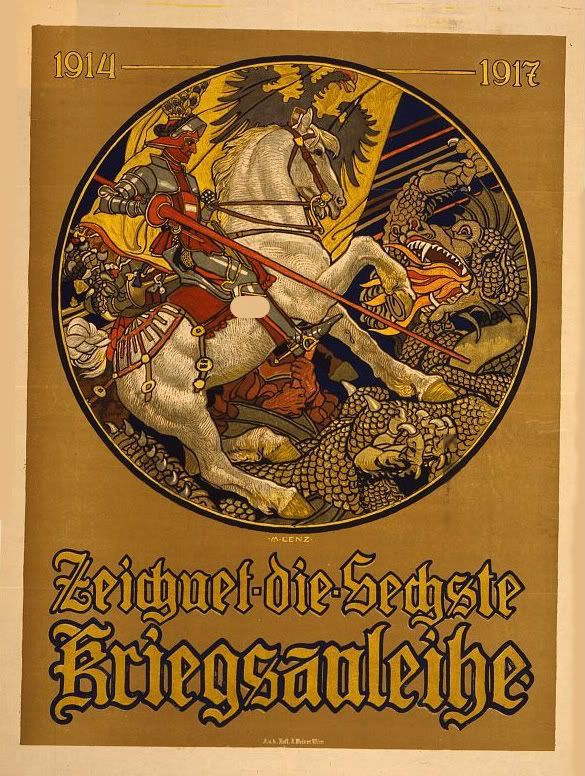
Poster showing a knight on horseback, with the Austro-Hungarian banner behind him, slaying a dragon. Text reads: Subscribe to the 6th War Loan, 1917.

Poster announcing an exhibit of images of the war, at the Kunstlerhaus, Vienna, Austria. 1918.

Poster showing a young woman offering a bowl of coins at an alter decorated with the Austrian coat of arms. Text: Union Bank, 8th War Loan; while on the alter it reads Peace through Victory,1918.


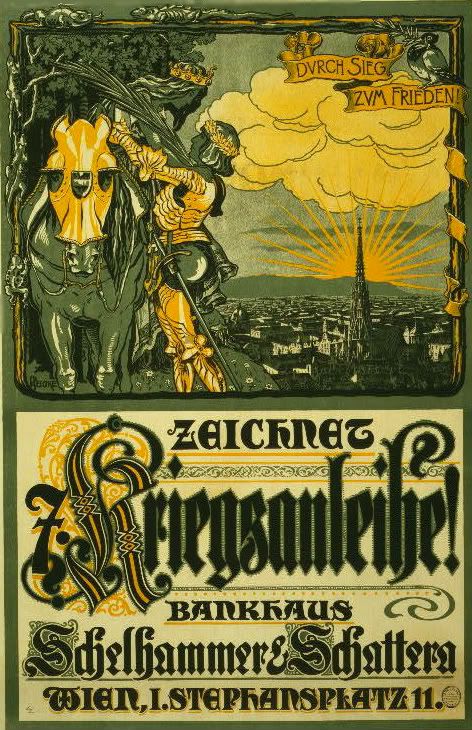
Poster showing a framed picture of a medieval knight with a laurel wreath on his head reaching up to help a woman wearing a crown seated on a horse. In the background can be seen Vienna with St. Stephens Cathedral and the slogan "Durch Sieg zum Frieden" or Peace through victory. Text reads: Subscribe to the War Loan, Bankhouse Schelhammer & Schattern.


Poster showing a medieval knight with the Austrian Imperial eagle on his tunic, standing in front of an Austrian banner, with his sword raised as if about to strike. The text tells people to subscribe to the 5th War Loan at the Zivnostenska Banka.

Advertising poster showing a large Roman style helmet. The text advertises an exhibition called "Art in War" in Berlin, 1916.

A poster showing two cherubs decorating a German helmet with garlands of flowers. Text reads: "Altona's War Relief Flower Day". The Poster also announces the opening of the Flower Exhibit at the Kaiserhof, 1916.

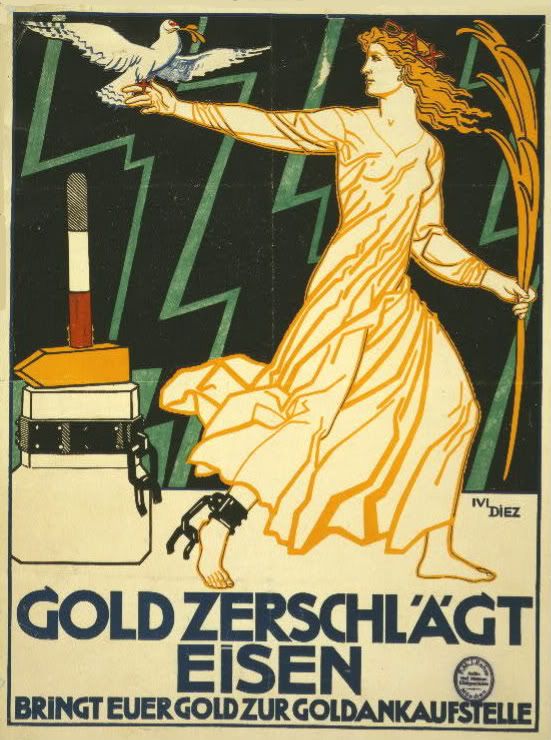
Poster showing a woman, representing Peace, with a dove on one hand and a golden sheaf in the other. The chain on her ankle has been broken, by the golden hammer resting on the anvil to which she was chained. The text encourages people to sell their gold to the government.

Poster showing a German soldier holding a child in his arms, behind him is a woman and child. Text reads: Fatherland, family, future -8th War Loan, 1918.


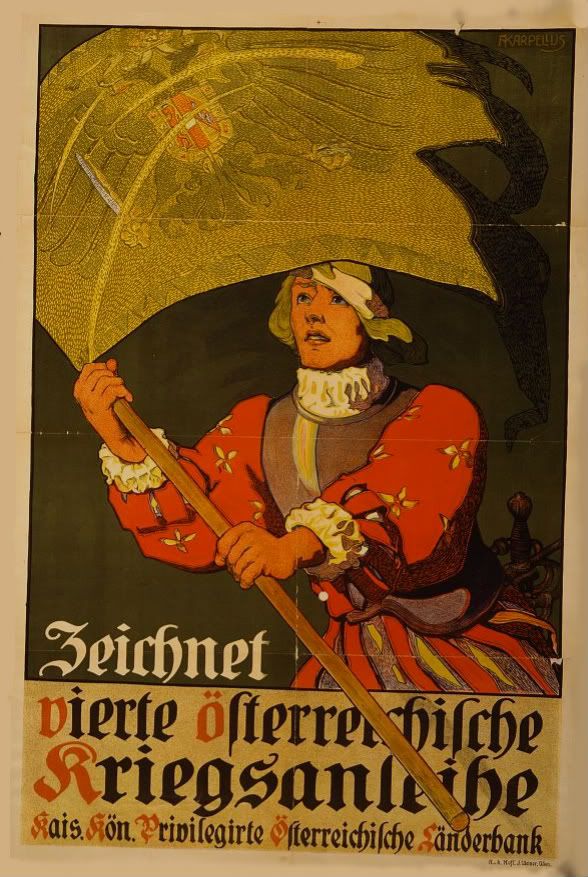
Poster showing a 16th century soldier holding up a flag with the Austro-Hungarian double-headed Imperial eagle on it. Text reads: Subscribe to the 4th Austrian War Loan, 1916.

The heralding of peace

Image Credit: G W Stephenson, Library Of Congress.

Photograph shows the U.S. Capitol building in Washington, with reflection in pool in the foreground. November 11 1921, the date of the first celebration of Veterans Day.

More Information.