10 Railyard Releated Photographs By Jack Delano

Image Credit: Jack Delano, Library of Congress, Office For War Information Collection.

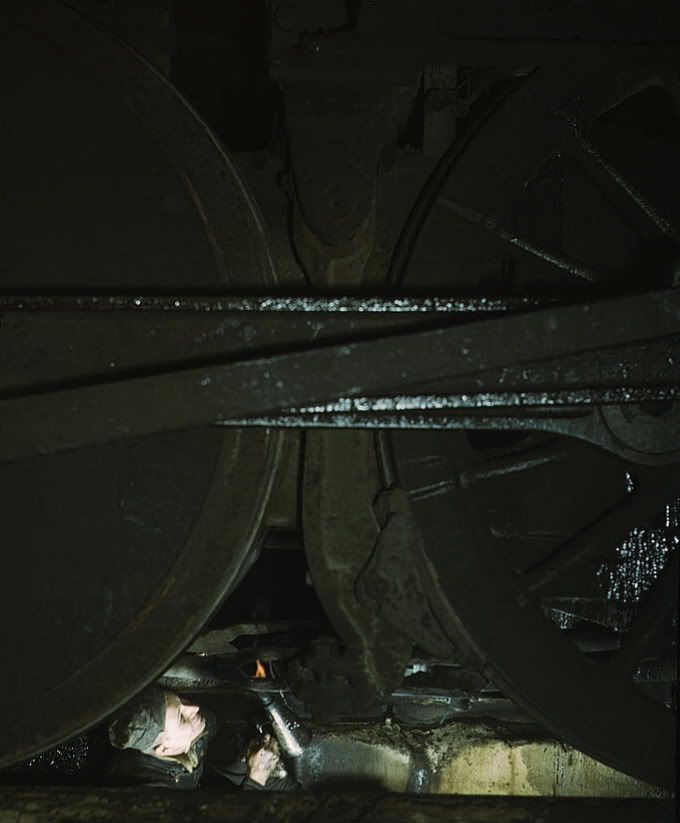
Worker inspecting a locomotive on a pit in the roundhouse at the C & NW Rail Road's Proviso yard, Chicago. December 1942.
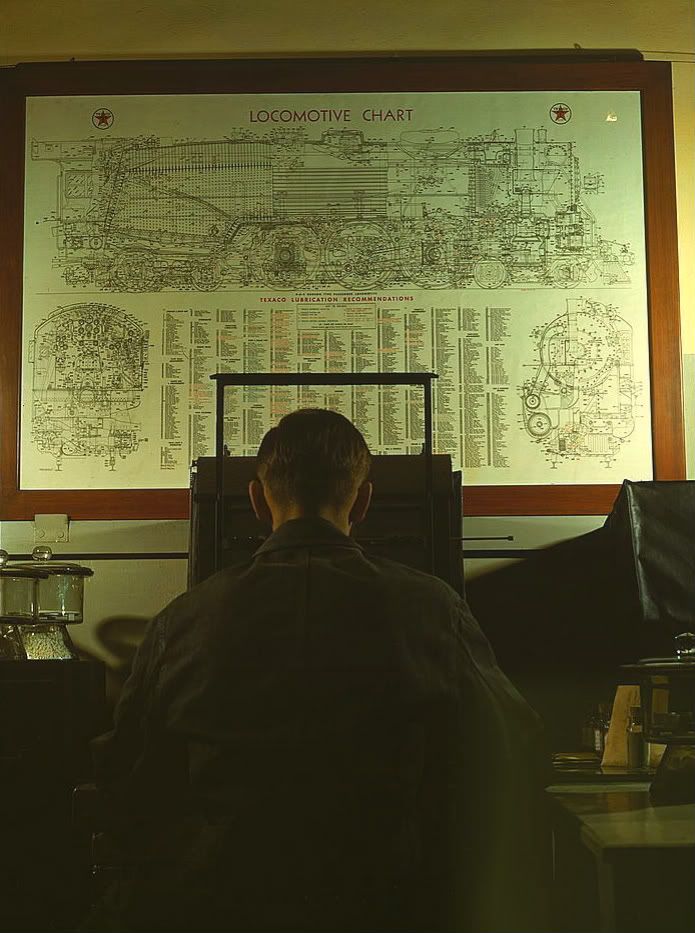
Image Credit: Jack Delano, Library of Congress, Office For War Information Collection.

Locomotive lubrication chart in the laboratory of the Chicago and Northwestern Railroad seen above a laboratory assistant who is working at a precision balance. Chicago, December 1942.

Image Credit: Jack Delano, Library of Congress, Office For War Information Collection.

March 1943. Santa Fe Rail Road. Retiring a locomotive driver wheel, Shopton, Iowa. The tire is heated by means of gas until it can be slipped over the wheel. Contraction on cooling will hold it firmly in place.
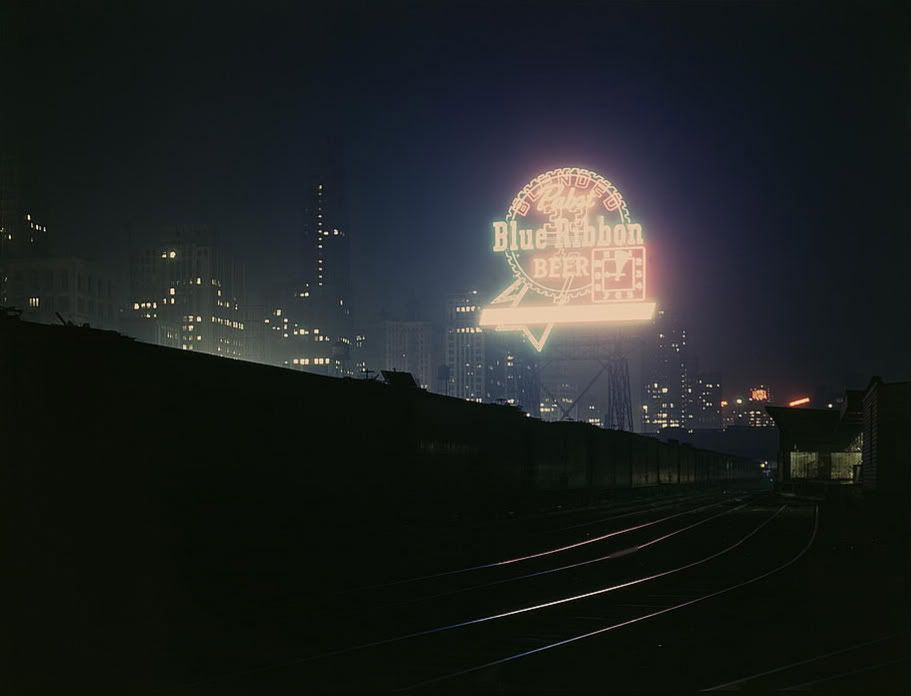
Image Credit: Jack Delano, Library of Congress, Office For War Information Collection.

Photograph of the Pabst Blue Ribbon neon sign, from the Central Railroad freight terminal, Chicago. April 1943.
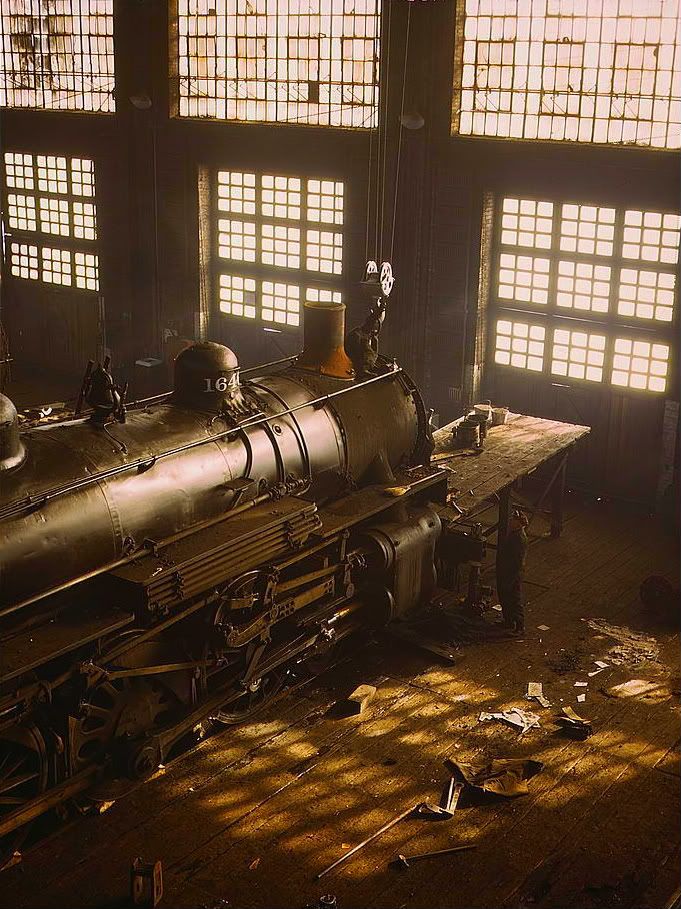
Image Credit: Jack Delano, Library of Congress, Office For War Information Collection.

Working on a locomotive at the 40th Street railroad shops, Chicago. December 1942.

Image Credit: Jack Delano, Library of Congress, Office For War Information Collection.

Locomotives over the ash pit at the roundhouse and coaling station in the Chicago and Northwestern Railroad yards, Chicago. December 1942.
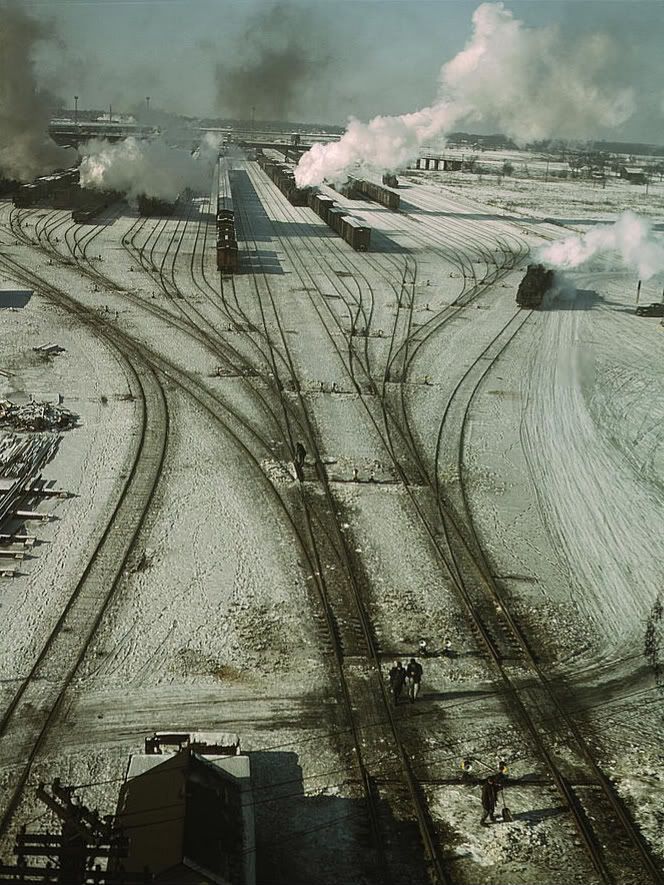
Image Credit: Jack Delano, Library of Congress, Office For War Information Collection.

General view of one of the classification yards of the Chicago and Northwestern Railroad yards, Chicago. December 1942.

Image Credit: Jack Delano, Library of Congress, Office For War Information Collection.

Servicing engines at coal and sand chutes at Argentine yard, Santa Fe Rail Road, Kansas City, Kansas. March 1943.

Image Credit: Jack Delano, Library of Congress, Office For War Information Collection.

General view of a classification yard at Chicago and Northwestern Railroad Rail Road's Proviso yard, Chicago. December 1942.
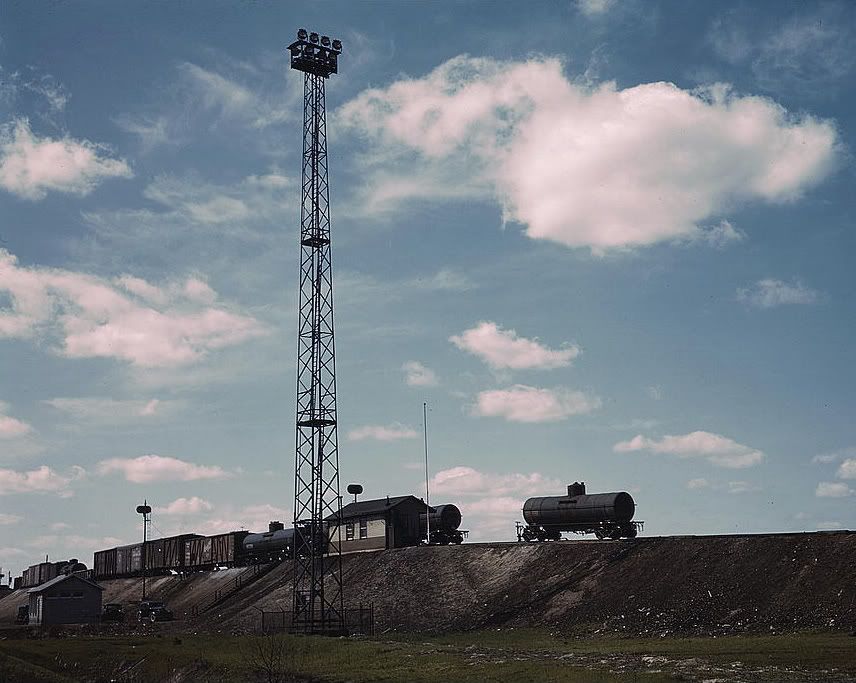
Image Credit: Jack Delano, Library of Congress, Office For War Information Collection.

Tank cars going over the hump at Proviso yard, Chicago and Northwestern Railroad Road, Chicago. April 1943.


More Information.


A Collection Of Old Magician's Promotional Posters

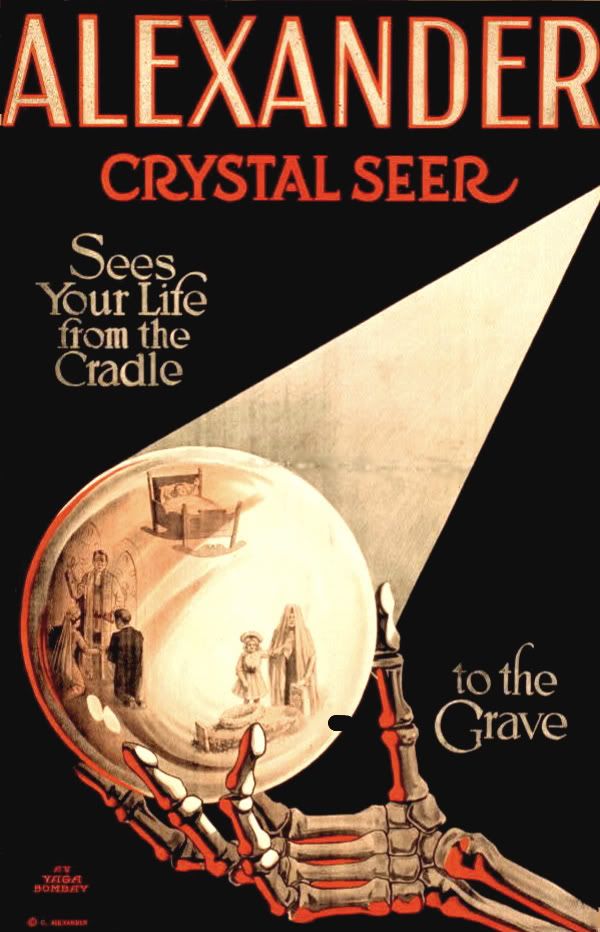
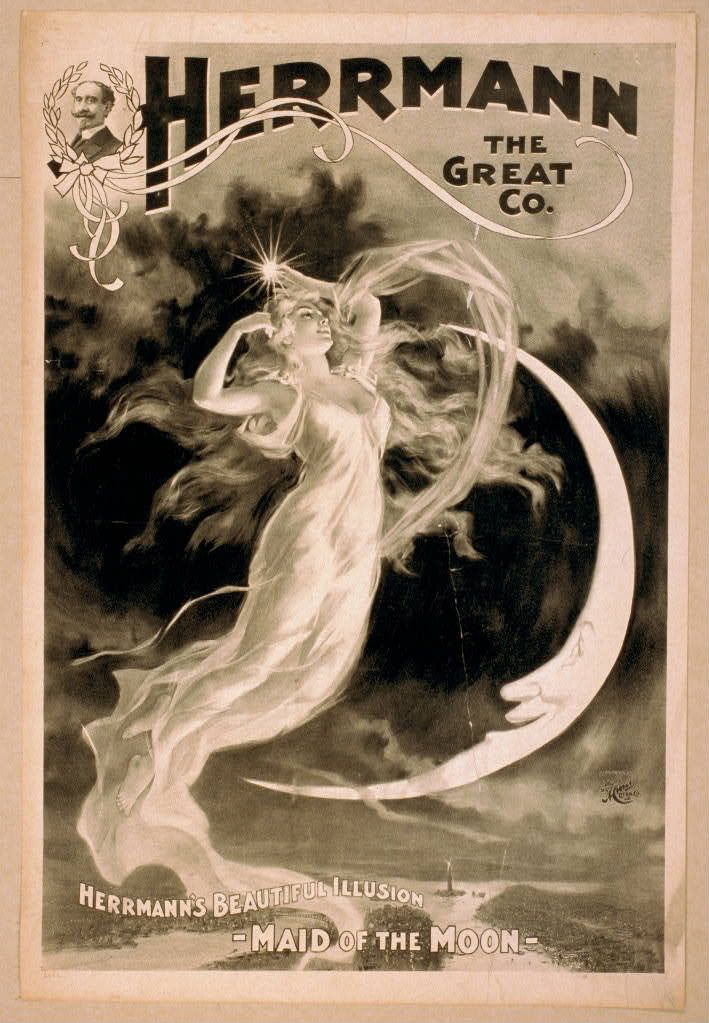
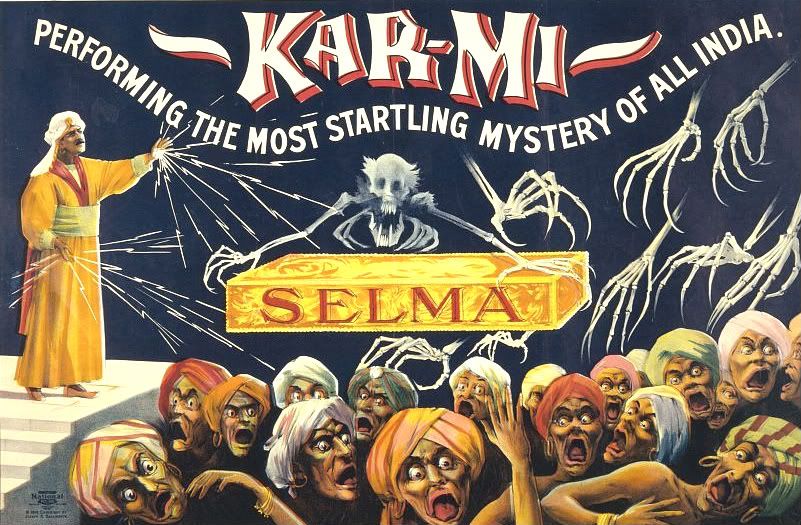
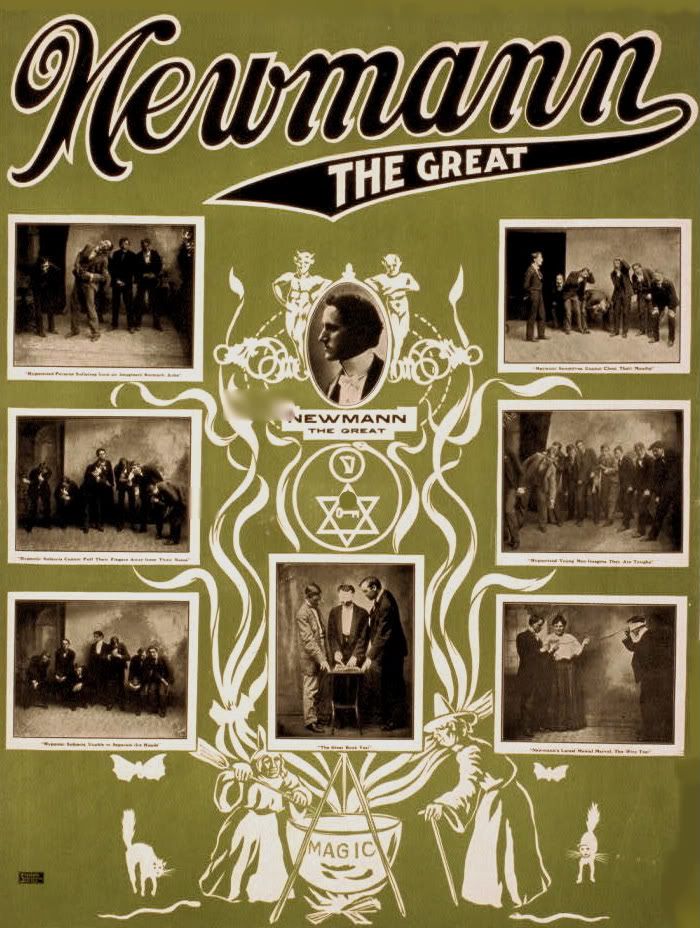
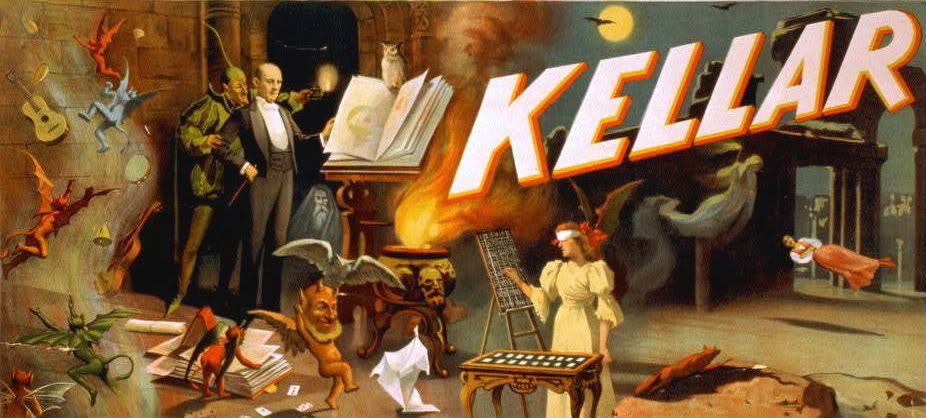
A collection of old magician's promotional posters, produced mainly between 1880 and 1925, the posters are mainly lithographic prints produced by promotional companies to advertise tours or stage shows that were being performed.


Herrmann The Great (Alexander Herrmann)


Kar-mi poster circa 1914.

Newman The Great poster circa 1898.


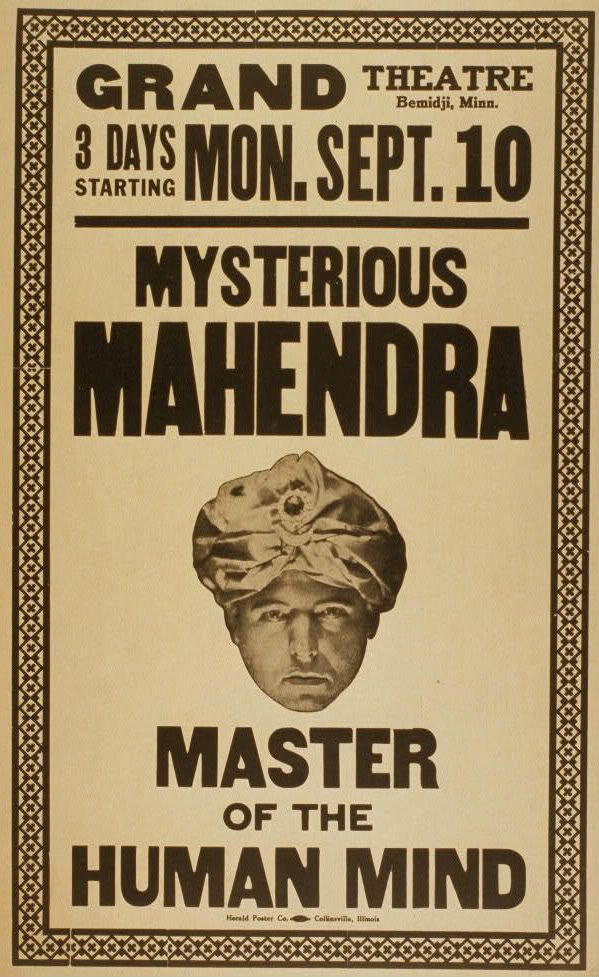
The Mysterious Mahendra poster circa 1923.


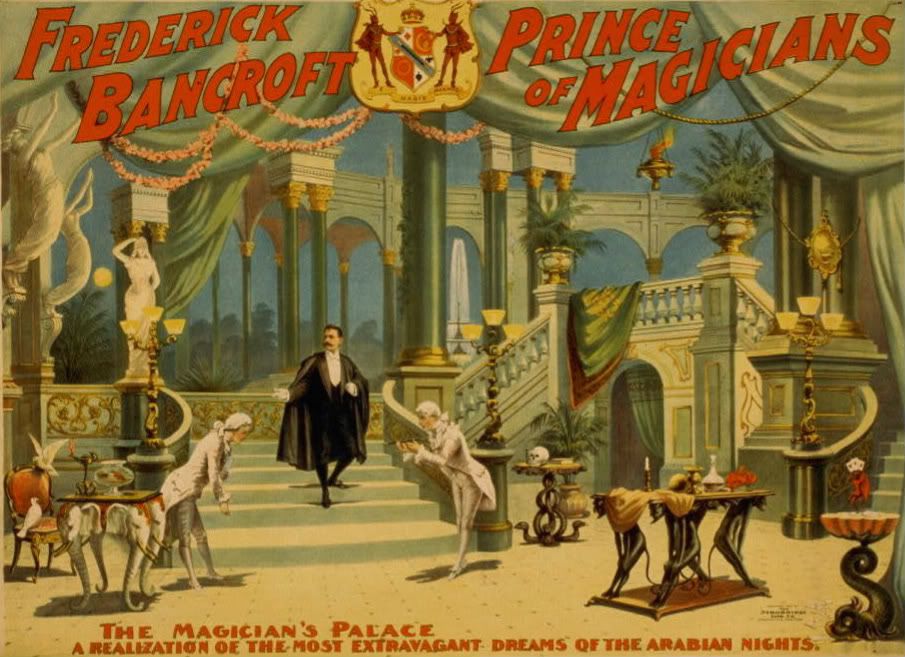
Frederick Bancroft Prince Of Magicians


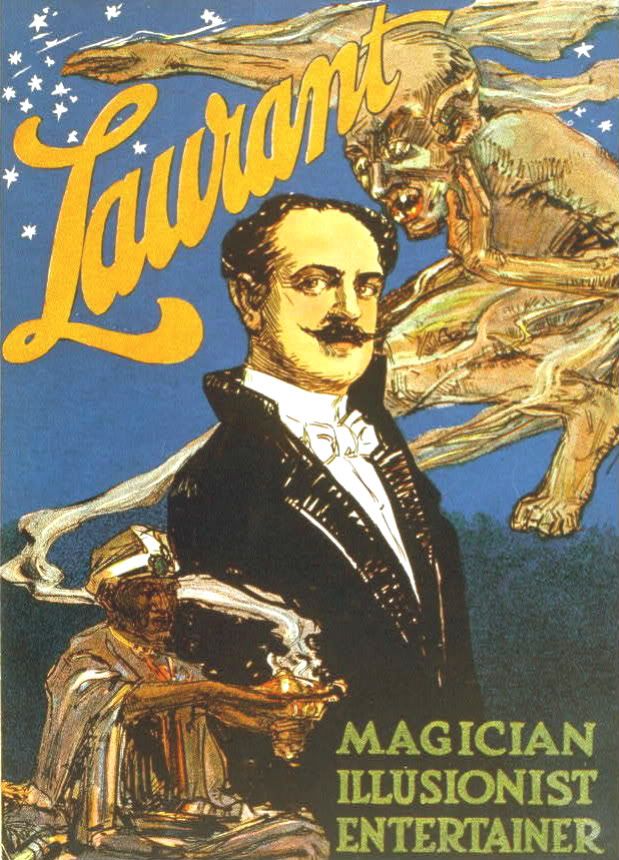
Laurant poster 1913


Von Arx ( Charles Albert Nicol)


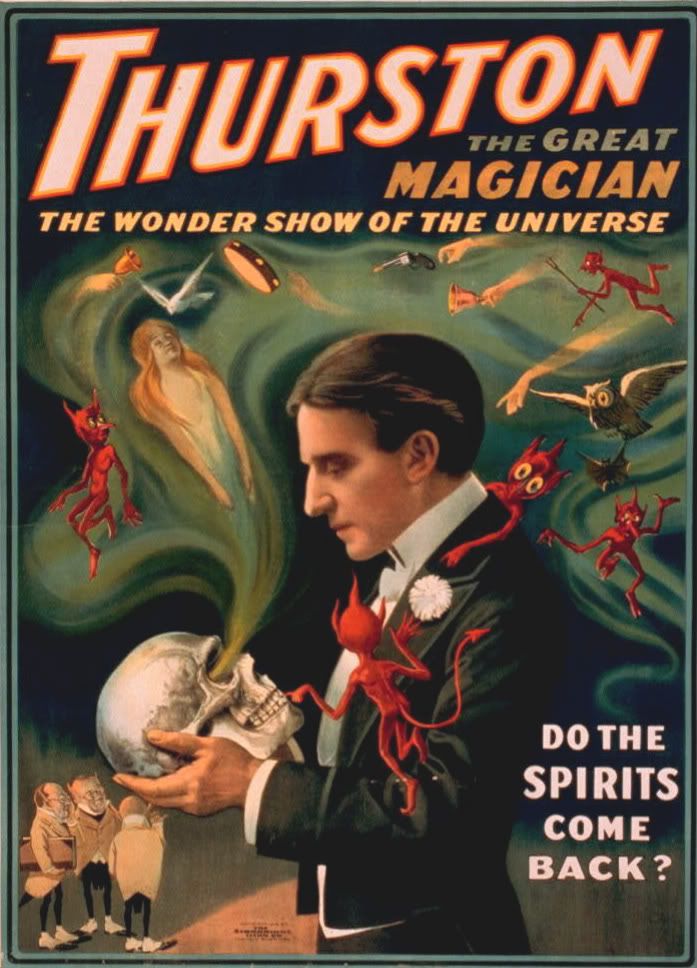
Thurston The great Magician poster 1915
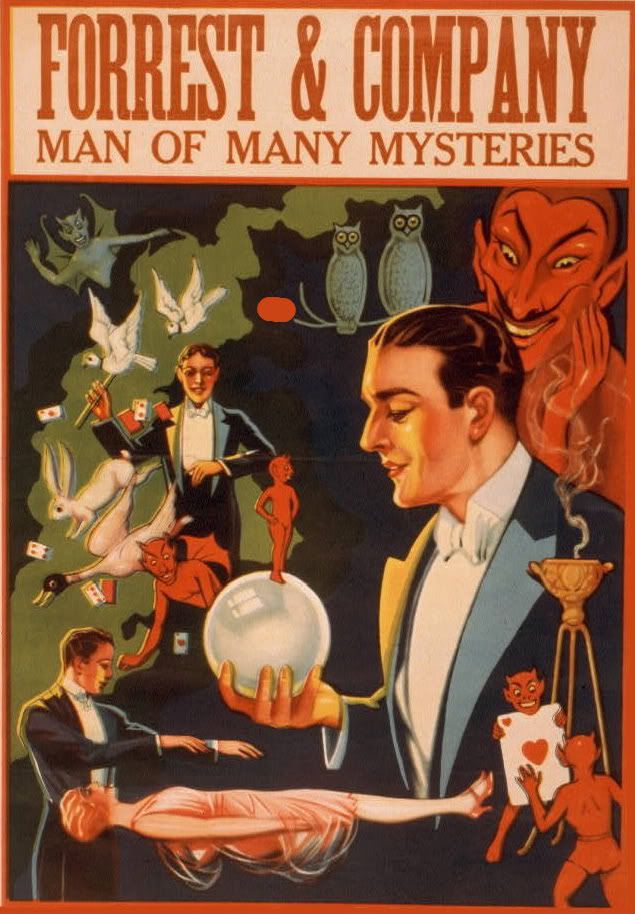

Forrest And Company


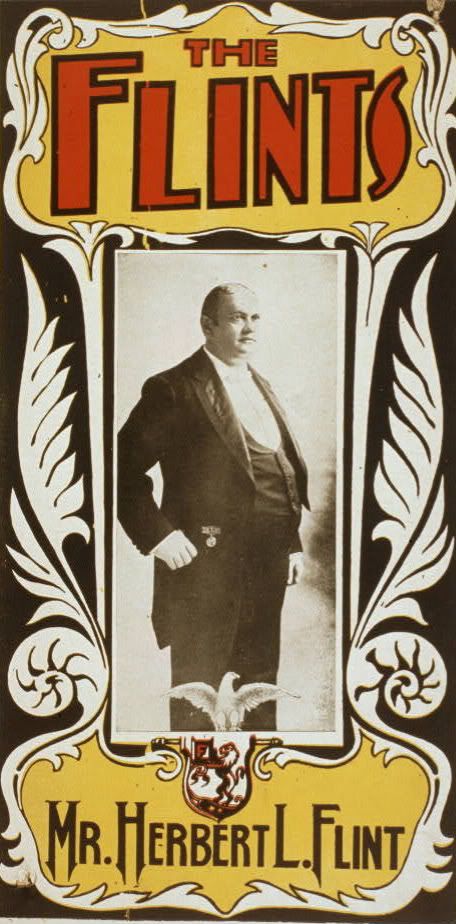
The Flints
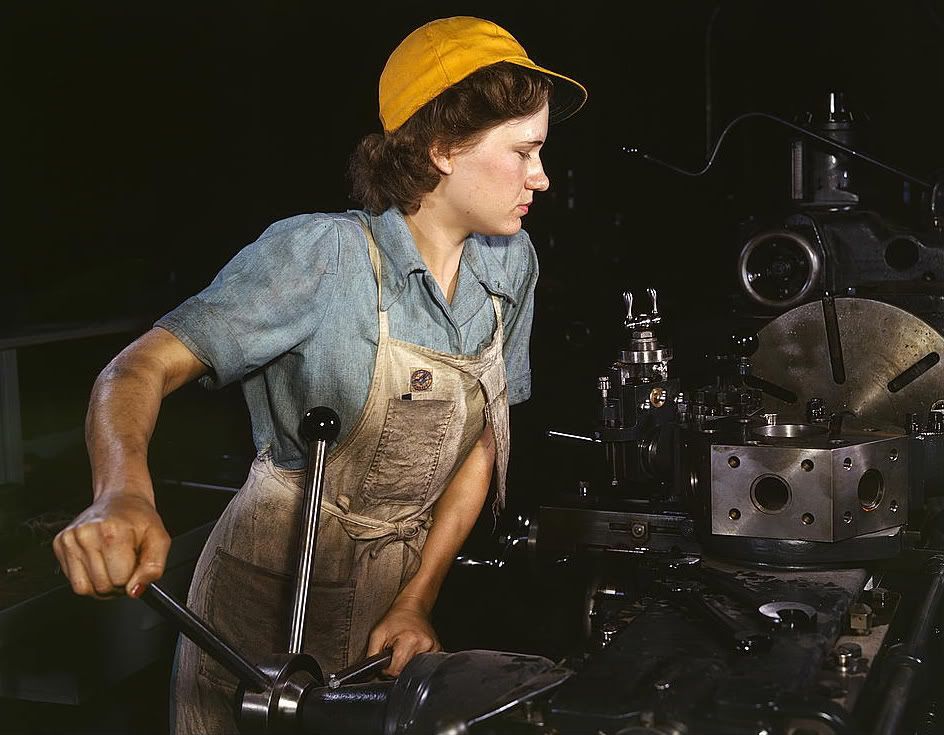

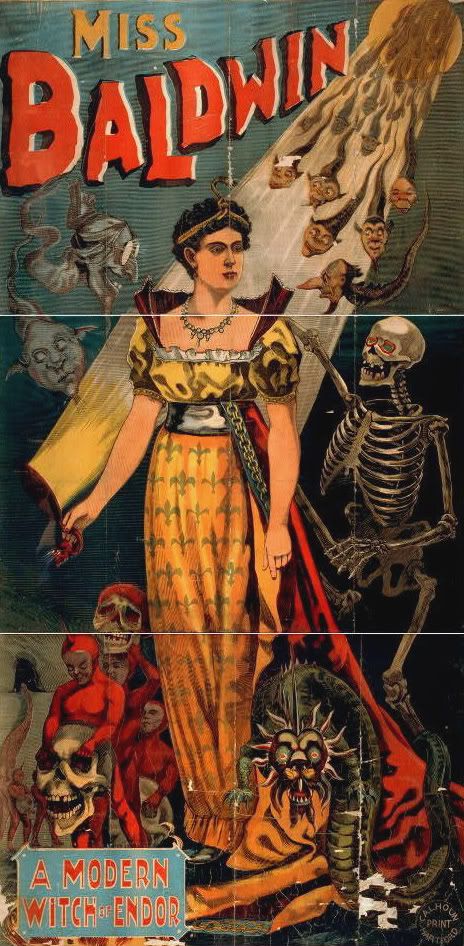
The Baldwins


Hartz, premier conjurateur poster 1900.

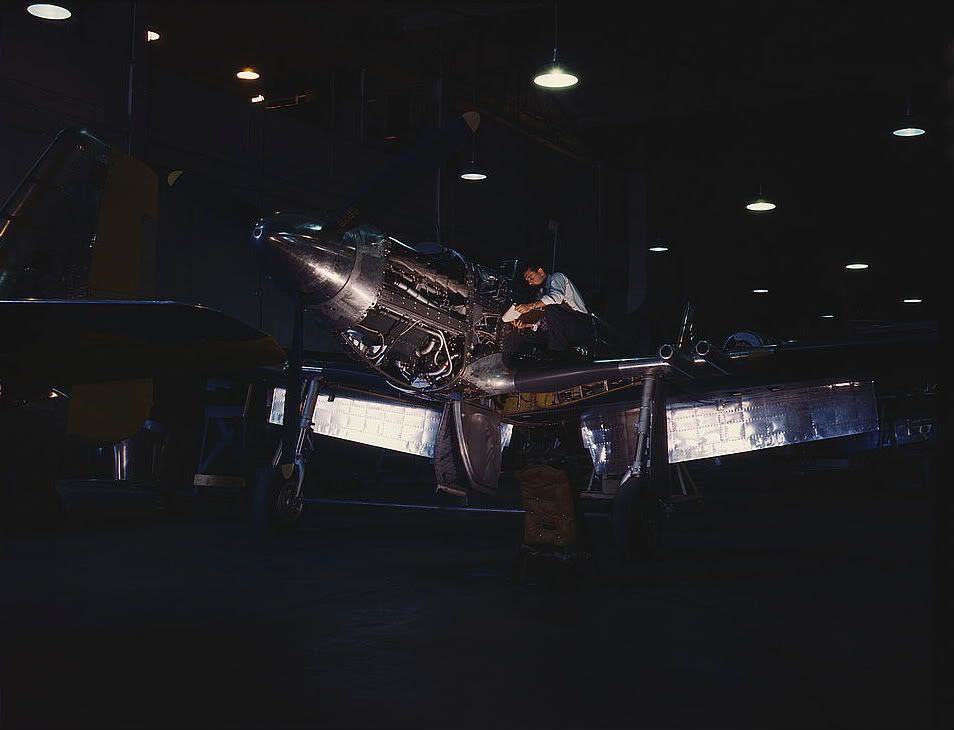
P-51 Mustang under construction, 1942.

Image Credit: Alfred T Palmer, Office Of War Information, The Library Of Congress.
P-51 "Mustang" fighter plane under at North American Aviation, Inc., Los Angeles, California, 1942.

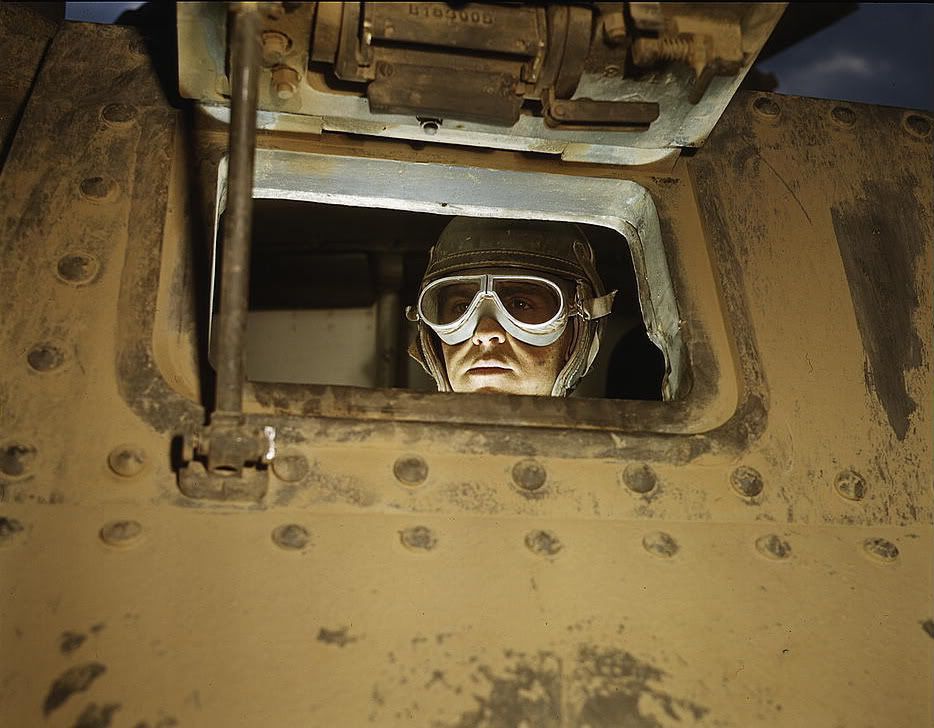
Tank Driver


Image Credit: Office of War Information, 1944.

Tank driver by Alfred T Palmer: Fort Knox, Kentucky

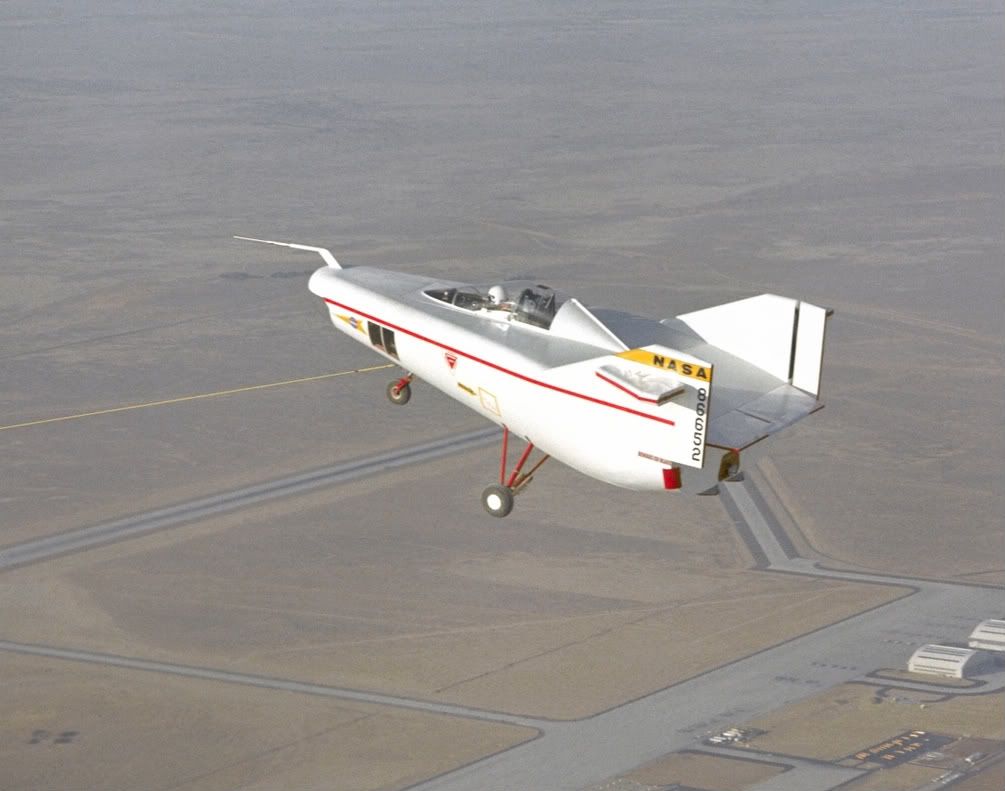
Don't be Rescued from Outer Space - Fly Back in Style, the M2-F1 programme.

M2-F1 in flight 1964 Image Credit : NASA Dryden Flight Research Centre photographic collection.

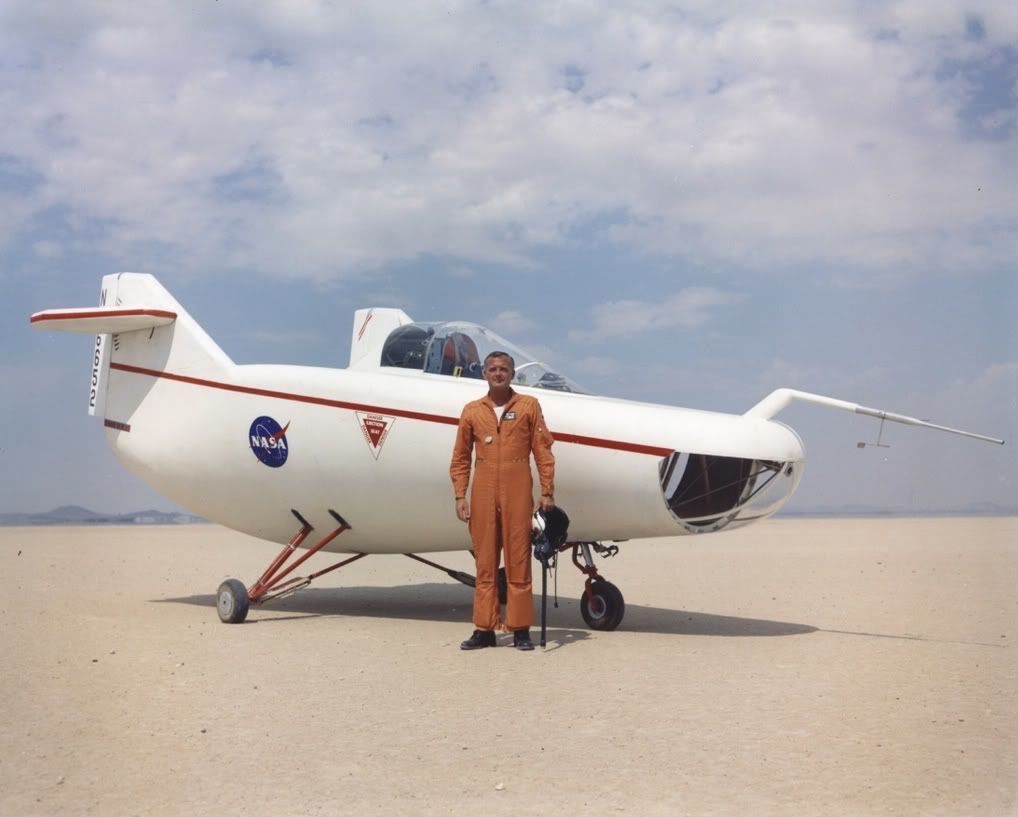
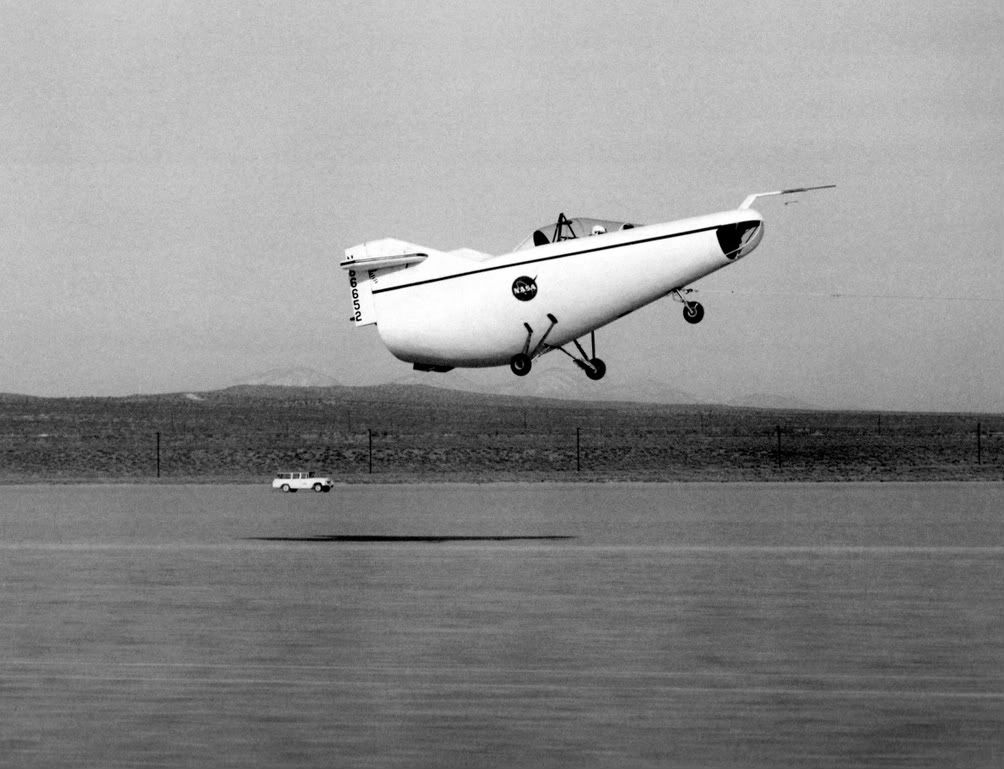
Flown from 1963 until 1966 the M2-F1(M referring to manned and F referring to flight version), dubbed the "flying bathtub" by the media, was the first design concept for a safe return vehicle that could be steered during atmospheric re entry. The wingless aircraft design was conceived as a means of landing an aircraft horizontally after atmospheric reentry. The absence of wings making the extreme heat of re-entry less damaging to the vehicle.

August 1963, Milt Thompson, test pilot and early champion of the project, on Rogers dry lakebed with m2-f1, Image Credit: NASA Dryden Flight Research Centre photographic collection.

Based on 1950's design concept of Alfred J. Eggers at the Ames Research Center, California. The M2-F1 was a precursor to the M2-F2, M2-F3, HL-10, X-24A, and X-24B lifting bodies. Their unpowered approaches and landings showed that re entry vehicles, like the Space Shuttles, did not need to carry the fuel and engines required for conventional powered landings. This enabled increased payload capacity and hence more cost effective launches.

In February 1962 R. Dale Reed, an engineer at Dryden, built a model based upon the Ames M2 design and air-launched it from a radio controlled "mothership." Film taken from the models flight persuaded Dryden facilities director, Paul Bickle, to green light the construction of a full-scale version, to be used as a wind tunnel model and possibly flown as a glider.

1963 photo shows Pontiac tow vehicle in a hanger with the m2-f1 lifting body.Image Credit : NASA Dryden Flight Research Centre photographic collection

The M2-F1 was built over a four-month period in 1962-63. The design stuck to the NASA concept of better, faster, cheaper, being built for about $30,000, with an additional $10,000 for the all important ejection seat. The design costs were kept low with NASA engineers building the tubular steel interior frame in house, reusing the landing gear from a Cessna 150, and outsourcing the plywood shell construction to Gus Briegleb and co, a local sailplane builder.


Image Credit : NASA Dryden Flight Research Centre photographic collection. 1963 low speed car tow.

For the initial use of a ground-tow vehicle NASA engineers used a souped up Pontiac convertible. On April 5 1963, Using a 1000 foot rope fastened to the NASA Pontiac, at Rogers Dry Lake, Milt Thompson piloted the M2-F1 for the first time on-tow. The speed was 86 miles per hour, allowing the craft to just about become airborne. Speeds on-tow later reached 110 miles per hour, enabling the M2-F1 to rise about 20 feet in the air before gliding for about 20 seconds.


M2- F1 mounted in Ames Research Centre wind tunnel Image Credit : NASA Dryden Flight Research Centre photographic collection.

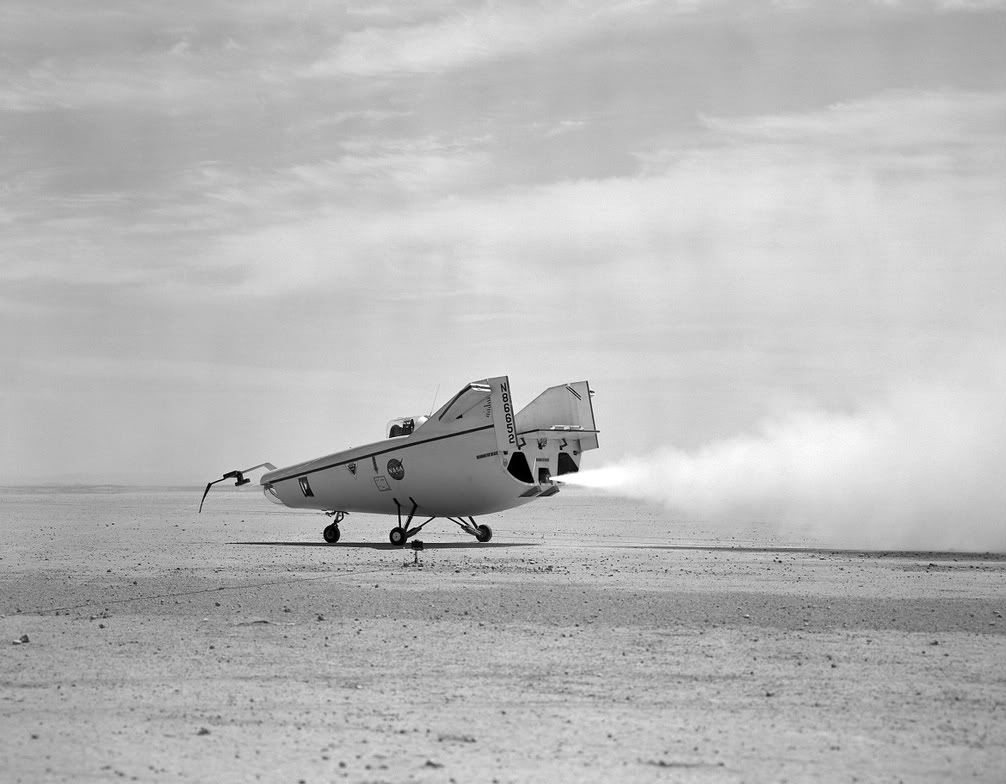
In the spring of 1963 the M2-F1 was shipped to the Ames Research Center wind tunnel For two weeks of tests. After this testing phase it was decided to use a C-47 tow plane to undertake aero tows, the first of which was on August 16 1963. Rockets were also installed in the tail to extend the landing flare for about 5 seconds.


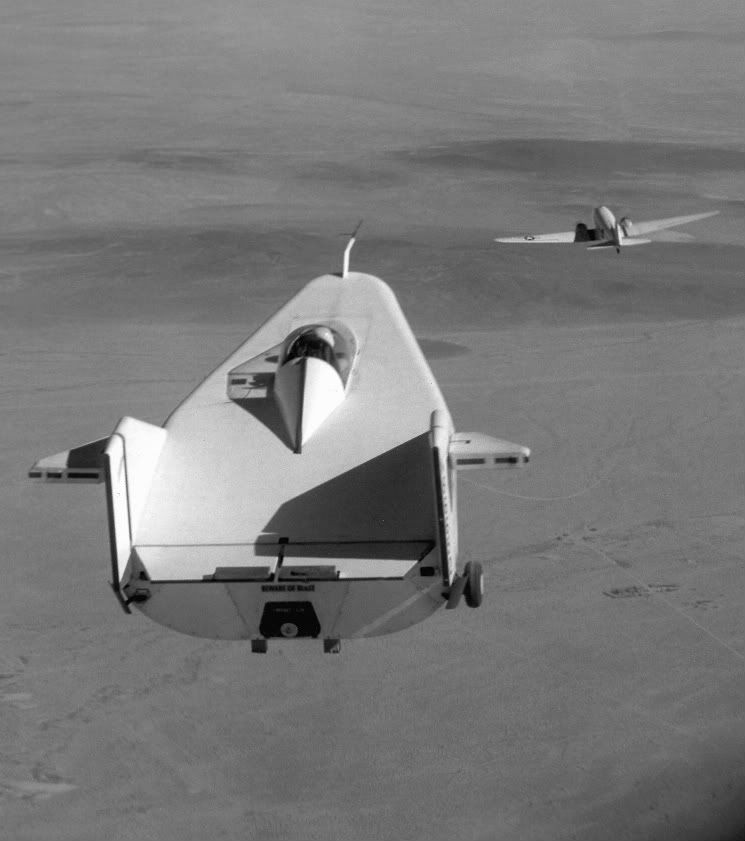
1964 picture of M2-F1 towed behind C-47 Image Credit : NASA Dryden Flight Research Centre photographic collection

The initial tow from the C-47 was released at 12,000 feet. The lifting body descended at approximately 3600 feet per minute. When the descent had reached 1000 feet, the nose of the M2-F1 was lowered to increase speed to nearly 150 miles per hour, the flare was at 200 feet from a 20-degree dive. The landing was reported as smooth.


Ground test of rocket Image Credit : NASA Dryden Flight Research Centre photographic collection.

Overall, more than 400 ground tows and 77 aircraft tow flights were carried out with the M2-F1. The success of Dryden's M2-F1 program led to NASA's development and construct the M2-F2 and the HL-10 programmes, and the U.S. Air Force's X-24 program.


1965 photograph of the M2-F1 in flight Image Credit : NASA Dryden Flight Research Centre photographic collection

The M2-F1 programme had demonstrated the feasibility of the lifting-body concept for horizontal landings of atmospheric entry vehicles, and that projects could be done cheaply and quickly. The entire project had cost approximately $50,000, excluding salaries of government employees assigned to the project.


More Information.


A quick walk through the Bethlehem-Fairfield Shipyards Inc.1941

I have selected a small sample from the acclaimed 1941"Liberty Ship" photo essay by Alfred T Palmer. I selected the photographs he took between the ships berths, I feel this creates a more focused view of life around the liberty ships as opposed to the construction and loading addressed more fully in the entire essay collection. I hope that the presentation gives an impression of walking the docks, while the ships were being fabricated. The full collection can be accessed through the Library Of Congress.

Here are two members of the Liberty Fleet lying at anchor in the basin of a large Eastern shipyard of the Bethlehem-Fairfield Shipyards Inc., Baltimore, Maryland. Of the two ships visible, the john Randolf was mined in the Denmark Strait 1942, later salvaged and hulked,before finally being scrapped 1952. The Richard Henry Lee survived the war before being Scrapped in 1965.

At ground level, between the ways of this large Eastern shipyard run tracks for flat cars carrying materials or sections to be hoisted onto the deck of ships under construction.

A flat car carrying materials to be hoisted onto the decks of ships under construction

Ships of the Liberty Fleet lying at anchor in the eastern basin of Bethlehem-Fairfield Shipyards Inc., awaiting final fitting and rigging. Identified here is the Roger B Tanney which was torpedoed and lost in the South Atlantic 1943.

Two members of the Liberty Fleet, one the Francis Scott Key which survived the war and was finally scrapped in 1967, lying at anchor in the basin of an Eastern shipyard, awaiting final fitting and rigging. Bethlehem-Fairfield Shipyards Inc., Baltimore, Maryland.

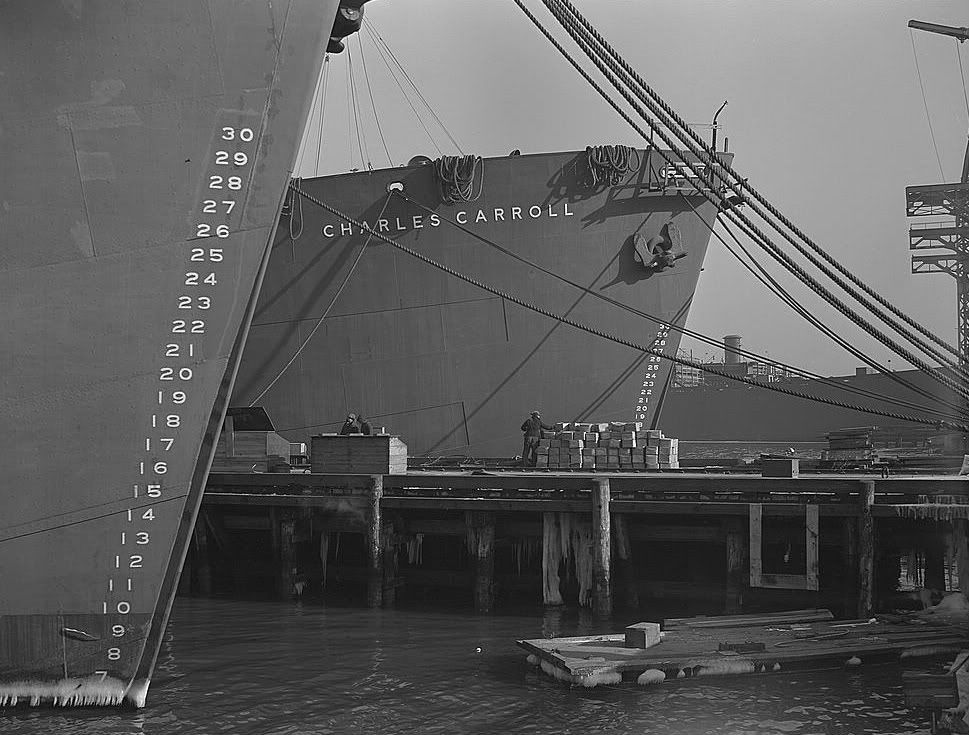
Lying at anchor in the basin of the Bethlehem Fairfield shipyard, awaiting final fitting and rigging, is the Charles Carrol, the ship survived the war and was not scrapped until 1971.

These flat cars loaded with prefabricated and assembled sections for ships under construction at a large Eastern yard are leaving nearby plant formerly used for the manufacture of Pullman cars.

Images Of Women At Work During War Time.

The following photographs were all produced by the office of war information in the early 1940's. The pictures were to be used in the production of posters by the Office Of War Information, primarily to encourage women to join the war effort by enrolling in training programmes to take on industrial jobs. In their unaltered form they show how the photographers strived to show interesting yet candid images of working women.


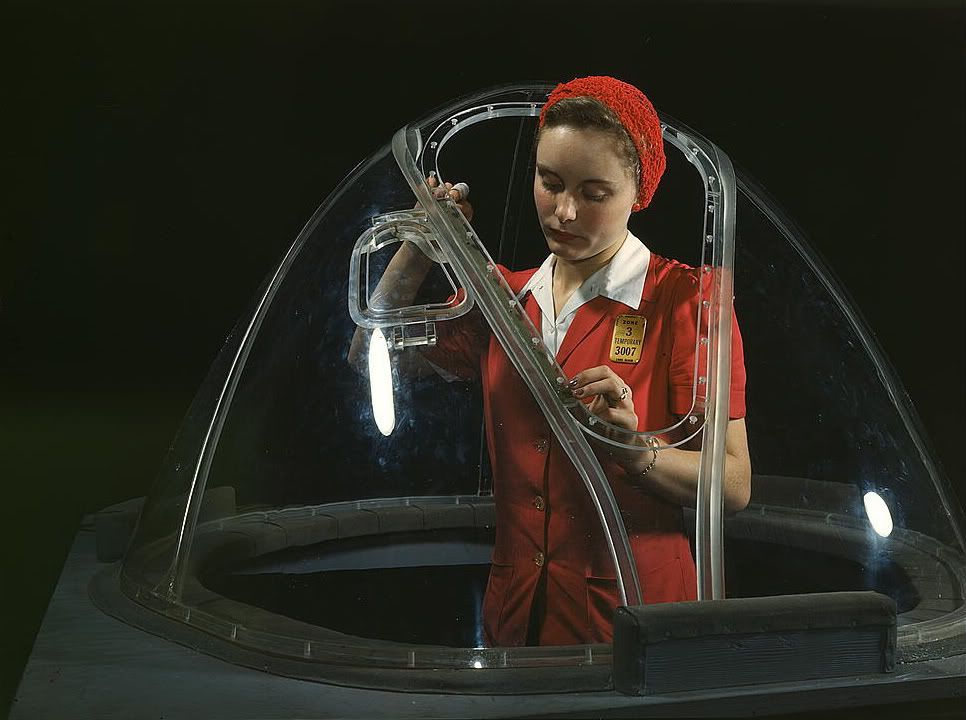
Girl In A Glass House Image Credit: Alfred T Palmer, The Library Of Congress Office Of War Information Collection.
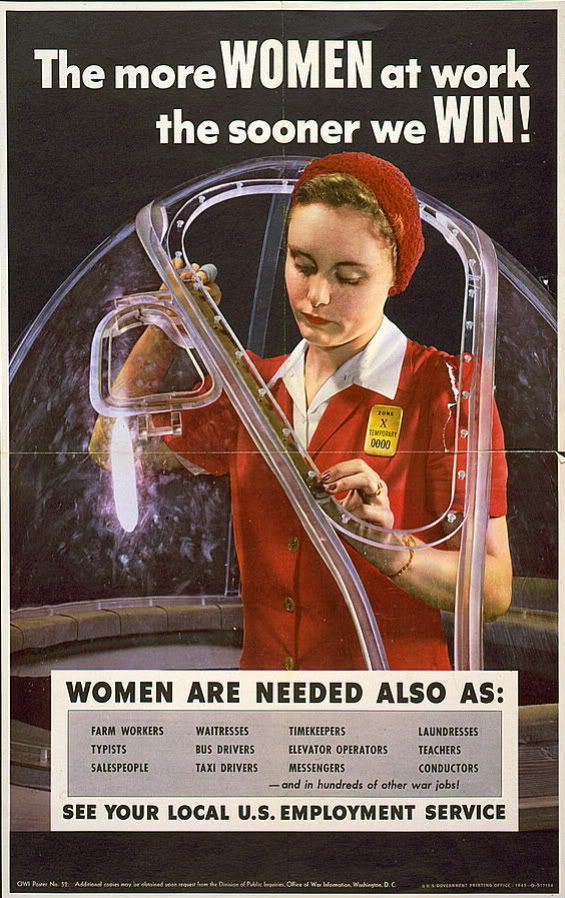
This "girl in a glass house" is putting finishing touches on the bombardier nose section of a B-17F navy bomber

The more women at work the sooner we win!
A Finished poster, note how the poster emphasises that young married women are the targeted group. The following photographs are all part of the same collection, but have no associated posters. It may be that they were not used, or that the images were used for other purposes, or that the posters were not saved.

Image Credit: Alfred T Palmer, The Library Of Congress Office Of War Information Collection.

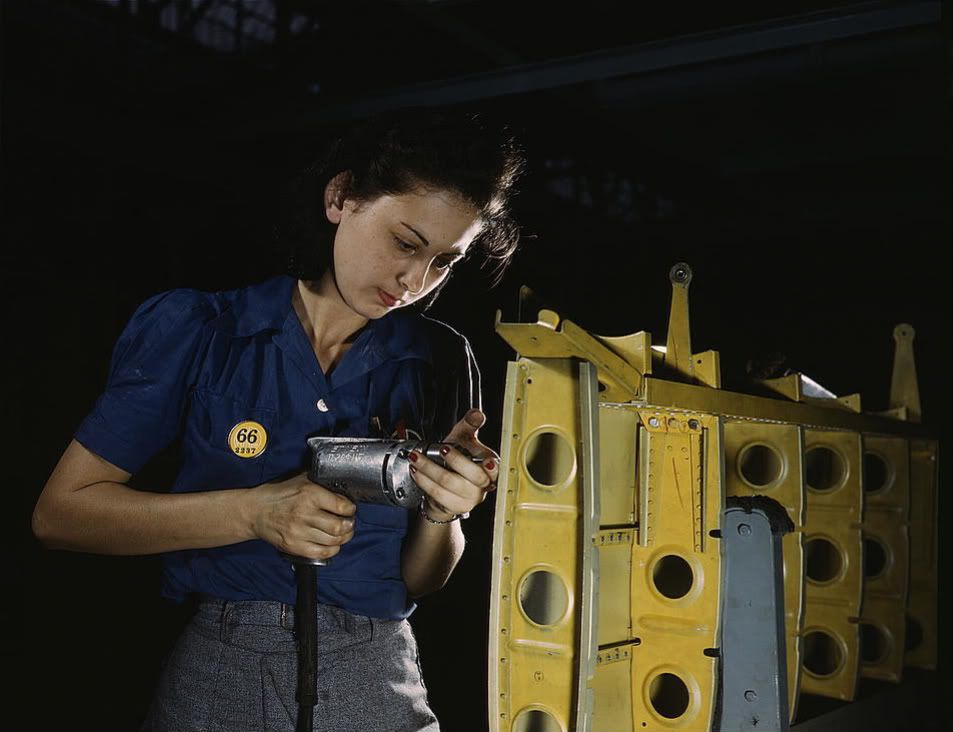
working on a "Vengeance" dive bomber, Tennessee.

Image Credit: Alfred T Palmer, The Library Of Congress Office Of War Information Collection.

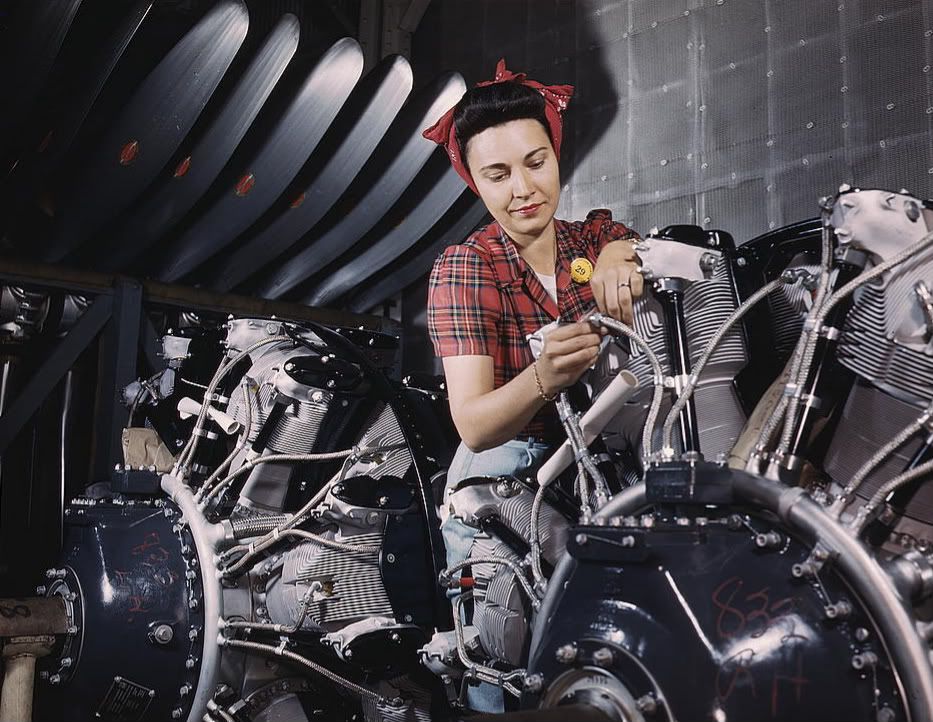
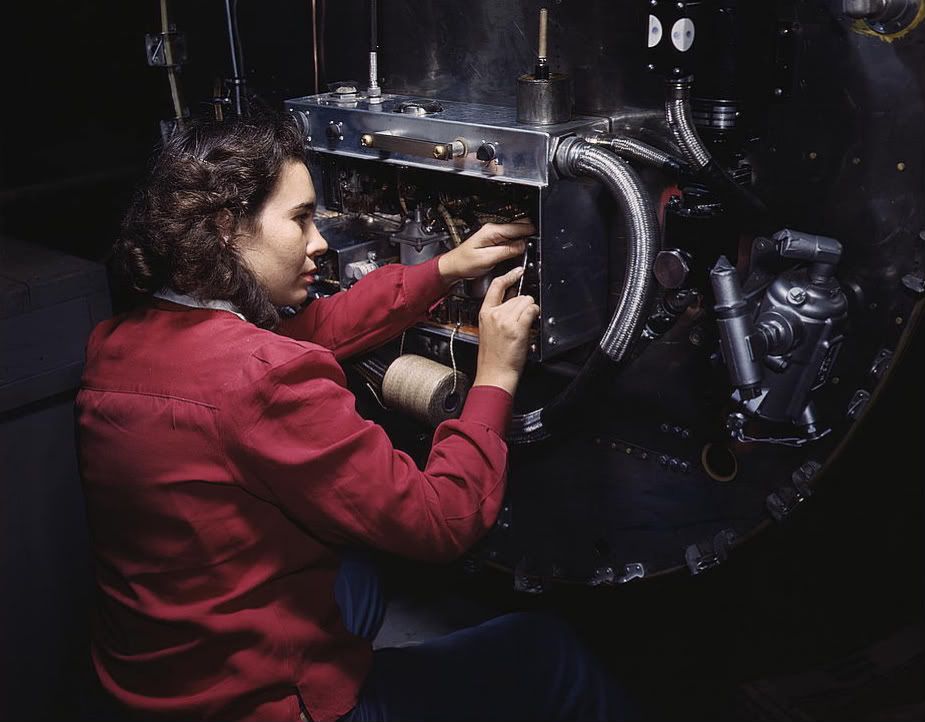
Woman working on an airplane motor at North American Aviation, Inc.,

Image Credit: Alfred T Palmer, The Library Of Congress Office Of War Information Collection.

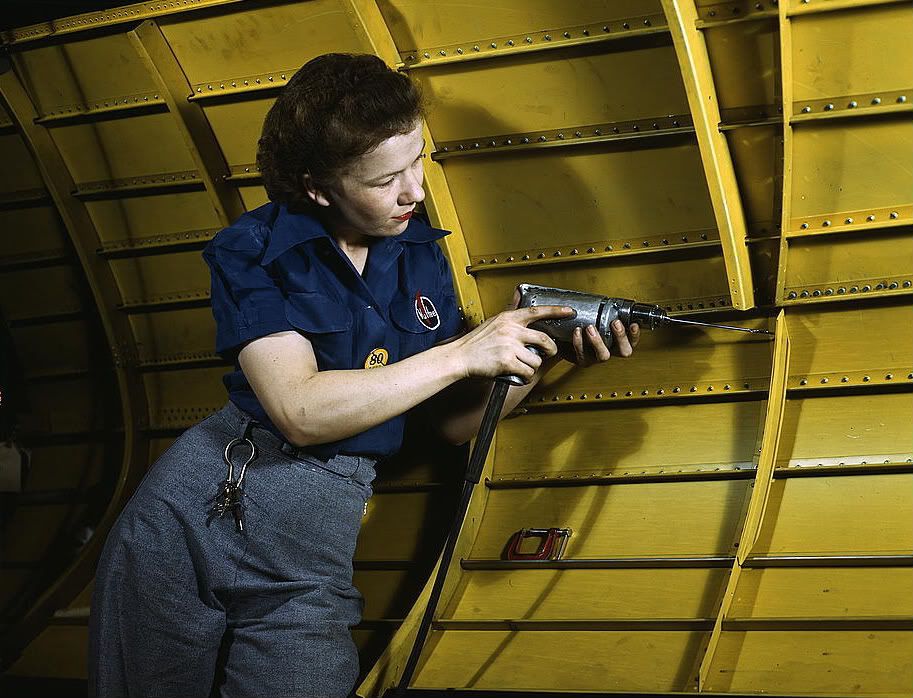
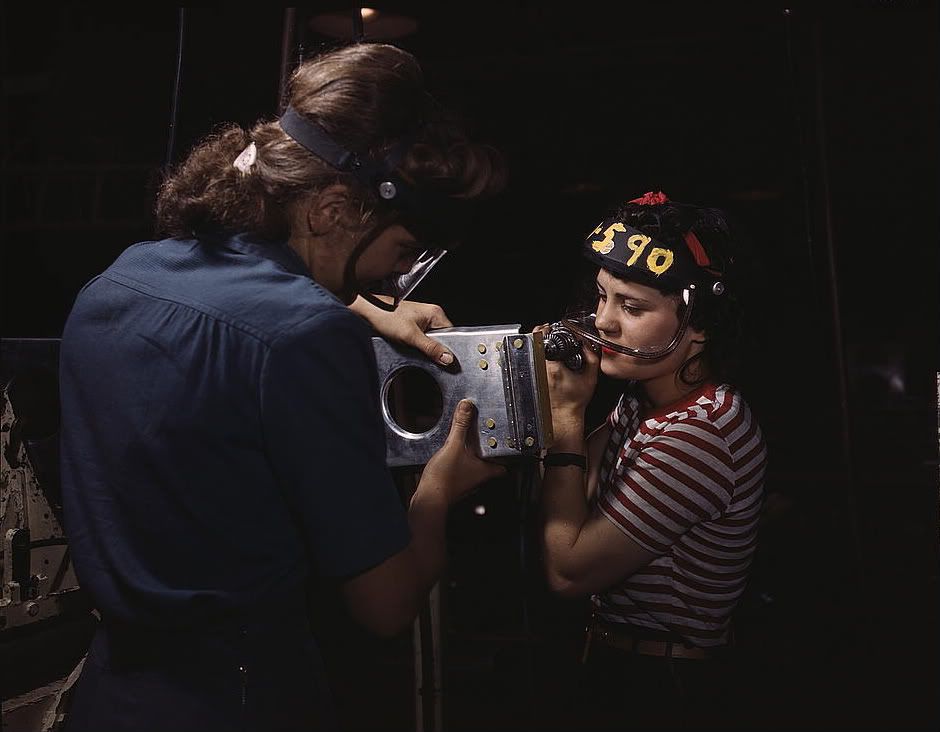
Drilling horizontal stabilizers: operating a hand drill, this woman worker at Vultee-Nashville is shown working on the horizontal stabilizer for a Vultee "Vengeance" dive bomber, Tennessee.

Image Credit: Alfred T Palmer, The Library Of Congress Office Of War Information Collection.

Switch boxes on the firewalls of B-25 bombers are assembled by women workers at North American Aviation, Inc.'s Inglewood plant.

Image Credit: David Bransby, The Library Of Congress Office Of War Information Collection.
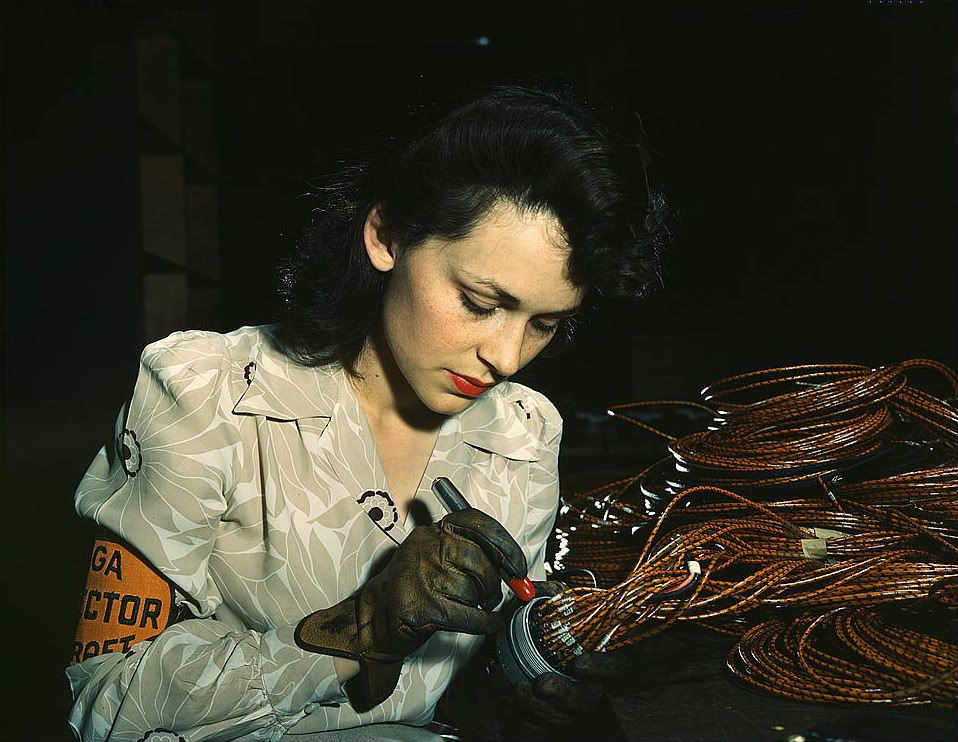
Woman aircraft worker, Vega Aircraft Corporation, Burbank, Calif. Shown checking electrical assemblies.

Image Credit: Alfred T Palmer, The Library Of Congress Office Of War Information Collection.

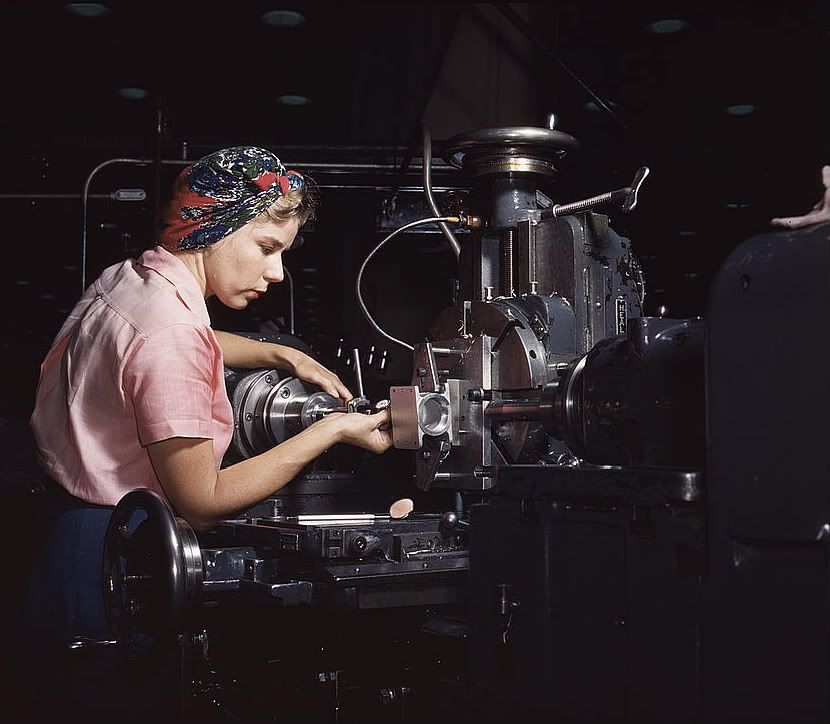
Woman machinist, Douglas Aircraft Company, Long Beach, California. 1942

Image Credit: Howard Hollam , The Library Of Congress Office Of War Information Collection.

Lathe operator machining parts for transport planes at the Consolidated Aircraft Corporation plant, Fort Worth, Texas.

Sunset Silhouette Of A Flying Fortress

Image Credit: Library of Congress, Office of War Information Collection

Sunset silhouette of a flying fortress, Langley Field, Va. 1942. Taken by Alfred T Palmer for the Office Of War Information.

Liberty Enlightening the World

Statue of Liberty enlightening the world, New York Harbor 1890.

Statue of Liberty or "Liberty Enlightening the World" is Located on the 12 acre Liberty Island in New York Harbour. Formally known as Bedloe's Island, a 1956 act of Congress officially renamed it Liberty Island.

poster advertising the tower featuring image of Frédéric Bartholdi

The statue, designed in 1876 by french sculptor Frédéric Bartholdi was designed to be a gift to the United States to mark the Centennial of the American Declaration of Independence. Alexandre Gustave Eiffel (designer of the Eiffel Tower) designed the massive iron pylon and secondary skeletal framework which allows the Statue's copper skin to move independently yet stand upright.The first model of the statue, built on a small scale, was completed in 1870 and is now in the Jardin Du Luxembourg, Paris.

Workmen constructing the Statue of Liberty in Bartholdi's Parisian warehouse workshop; Winter 1882.

The site in New York Harbor was chosen by General William Tecumseh Sherman in 1877 after an act of Congress. Sherman chose the site Bartholdi favoured, then known as Bedloe's Island, where there was already the star-shaped Fort Wood, which could act as the planned star shaped foundation to the pedestal base.

The torch and part of the arm of the Statue of Liberty, on display at the 1876 Centennial Exhibition in Philadelphia.

Head of Statue of Liberty on display in park in Paris 1883

Bartholdi had planned to have the statue completed by July 4 1876, but delays prevented it. However, the right arm and torch were completed. These parts of the statue were displayed at the Centennial Exposition in Philadelphia, where visitors were charged 50 cents to climb the ladder to the balcony.

Poster advertising the statue

The cornerstone of the pedestal, designed by American architect Richard Morris Hunt, was laid on August 5 1884. Construction had to be stopped due to lack of funds in January 1885, but resumed on May 11 1885 after more funds were raised, the pedestal was at last completed on April 22 1886.

Inauguration of the Bartholdi Statue, Harbor of New York-Military and naval salute, the President's arrival at Liberty Island 1886 Oct. 28,

The statue, which was stored for eleven months in crates waiting for its pedestal to be finished, was re-assembled over the next four months. The Statue of Liberty was unveiled by President Grover Cleveland on October 28th 1886, in front of thousands of spectators.


Statue of Liberty circa 1894.

More Information

Wikipedia article on the Statue Of Liberty

Welder Making Boilers For A Ship 1942.

Photograph, taken in June 1942, by Alfred T Palmer of a Welder making boilers for a ship at the Combustion Engineering Company, Chattanooga, Tennessee. The image was part of a photographic survey by the Office Of War Information.

photo credit: Alfred T Palmer collection at the Library OfCongress.

Photographs From The Great Lakes Steel Corporation.

These Photographs From The Great Lakes Steel Corporation, were taken by Arthur Siegel in November 1942 for the Office Of War Information, an agency created during second world war to consolidate government information services. They show the Great Lakes Steel Corporation, one of the few steel companies to survive Throughout the Great Depression as a profitable company, producing steel as part of the U.S war effort. The images of active, productive industry, were to be used for propaganda and informational studies. All photographs are courtesy of The Library Of Congress.


Coal tower over Hanna furnaces of the Great Lakes Steel Corporation, Detroit, Mich.

Coal feeders on tip of coke ovens, Hanna furnaces of the Great Lakes Steel Corporation, Detroit, Mich.

Coal pusher apparatus with coal storage, Hanna furnaces of the Great Lakes Steel Corporation, Detroit, Mich.

Coke being pushed into a quenching car, Hanna furnaces of the Great Lakes Steel Corporation, Detroit, Mich.

Snowy night.

image credit: Marion Wolcott Post, Woodstock, Vermontt March 1940.

Comparison Pictures Of The Three Inner Rocky Planets.

image credit: Venus - ESA, Earth - ESA, Mars - ESA © 2007 MPS for OSIRIS Team MPS/UPD/LAM/IAA/ RSSD/INTA/UPM/DASP/IDA

Comparison pictures of the three inner rocky planets, from the left, Venus, earth and mars.

The Five Best Railyard Pictures Taken By Jack Delano.

5) Worn tires on locomotive wheels being refaced in the wheel shop of the Chicago and Northwestern Railroad, December 1943.


4) A welder in the roundhouse of the Chicago and Northwestern Railroad's Proviso yard, December 1942.


3) The Santa Fe Railroad locomotive shops, Topeka, Kansas, March 1943.


2) Chicago and Northwestern railroad locomotive shops, Chicago, December 1942.

1) The roundhouse at a Chicago and Northwestern Railroad yard, Chicago, December 1942.


More information.


The railroad assignment given to Jack Delano by the F.S.A has been placed in an ordered slide show on Carr Tracks.

Mailboxes By Russell Lee


Mailboxes in Catron County, New Mexico 1944 taken by Russell Lee for the Farm Security Administration.

Déjà Vu In All Its Forms.

Déjà vu Déjà vu is the experience of feeling you have experienced or seen a new situation before, that is a past episode is repeating itself in the present, and that you remember it.

Déjà Vécu (already lived) Déjà vécu is what most people think of as Déjà vu. They have the think they have seen or experienced an event in great detail before, they may also have a feeling of knowing what is going to come next.

Déjà Visité (already visited) Déjà visité is the knowledge of buildings and places that you should not know as you have never been there before. You may know your way around a building or town despite never having visited before.
Nathaniel Hawthorne in his book Our Old Home wrote about an experience in which he visited a ruined castle and had a full knowledge of its layout. He later found out that his knowledge of the castle to a poem he had read many years early by Alexander Pope in which the castle was accurately described.

Déjà Senti (Already Felt) Déjà senti is the phenomenon of thinking you have already felt something novel such as a smell or touch.

Jamais Vu (Never Seen) Jamais Vu describes when a familiar situation is not recognized. It is often considered to be the opposite of déjà vu. The observer does not recognize the situation despite knowing that they have been there before. It is commonly explained as when a person momentarily doesn’t recognize a person, word, or place that they know. Studies of Jamais vu show that it may be a symptom of brain fatigue.

Presque Vu (Almost Seen) When one cannot recall a familiar word, name or situation. Presque vu is the sensation of being on the brink of a revelation, that is, having the answer"on the tip of the tongue."

Déjà Entendu (Heard Again) This is the feeling that you have already heard what you are now hearing. Déjà Entendu is the aural counterpart to Deja Vu.

Déjà raconté (Already Told) The feeling that you've already told someone somthing. First mentioned by freud with the possible explanation that you meant to tell someone but didn't, and thus constructed a false memory of having done so.

There are also some less well described forms of the déjà family of experiences.

Déjà Pensé Already thought of
Déjà Voulu Already desired, a memory disturbance were you believe that what you desire now is the same as before, despite now being different.
Déjà Eprouvé Already experienced or tested
Déjà Fait Already done
Déjà Reve Already dreamt
Déjà Pressenti Already sensed
Déjà Voulu Already desired
Déjà Su Already known
Déjà Trouve Already found
Déjà Dit Already said
Déjà Goute Already tasted
Déjà Halluciné Already hallucinated
Déjà Lu The feeling that one may have read the present passage or one very like it before.

Deja vu has commonly been thought to have its genesis in forgotten memories, fantasy or dreams. The feeling of Déjà vu wears off a few seconds or minutes, though its effects may linger in the mind for some time. There are two main classes of Déjà vu, associative and biological.

Associative déjà vu

The most common type of déjà vu experienced. It is associative in nature, that is you may hear, smell or feel somthing that reminds you of a similar experience, thus setting off the experience of Déjà vu.

Biological déjà vu

Biological déjà vu, is as the name suggests, caused by some physical, biological change in the brain. This can be from an injury, or more commonly caused by differing forms of epilepsy.
High occurrences of déjà vu among people with temporal lobe epilepsy have been reported. Just before having a seizure they may experience a strong feeling of déjà vu. There has however been some debate within medical research as to wether or not this is true Déjà vu as the person experiencing it may truly believe they've been through the exact situation before, rather than the traditional feelings associated with getting déjà vu.


Theories on the reasons for Déjà vu


1)The Hologram Theory

Memories are like holograms that you can recreate in your minds eye. The entire three-dimensional image can be recreated from any fragment of the whole memory. The smaller the memory fragment, however, the fuzzier the ultimate picture recreated in the minds eye.
Some detail in the environment such as a sight, sound or smell, similar to some memory fragment of our past, allows the brain to recreate an entire scene from that fragment.
For example, you might go for a walk in the country when you see a red tractor which seems somehow farmiliar. You might have subconsiously remembered a walk taken as a child with your parents were you saw a similar style of tractor in a similar setting.

2)Dual Processing (or Delayed Vision)

Dual Processing is based on the way our brain processes new information and how it stores long and short term memories. First proposed by Robert Efron at the Veterans Hospital in Boston in 1963. He proposed that a delayed neurological response causes déjà vu. Because information enters the processing centers of the brain via more than one path, it is possible that occasionally that blending of information might not synchronize correctly.

3)Other Sources Theory

The Other Sources Theory proposes that we have many stored memories that come not only our own experiences but also outside influences. This could be films, photographs and books. We can have very strong memories of things that we've read about or seen without actually physically experiencing them, over time, these memories may be pushed back in our minds.
When we see or experience something that is very similar to one of those memories, we experience a feeling of déjà vu. An example of this could be recognising a person, but not knowing why. You may have seen their picture in a paper years before but long since consciously forgotton seeing the picture.

NASA's Terra Satellite Captures An Arctic Eclipse.


Image Credit: NASA

NASA's Terra satellite was manoeuvring past the eastern tip of Siberia and across the Arctic Ocean towards northern Norway and northwest Russia, when it captured this unique view of a total solar eclipse on August 1 2008.
The shadow of the eclipse moved southeast across the surface of the Earth, At the same time as the satellite crossed the Arctic, with its path nearly perpendicular to that of the eclipse. The sun was completely obscured for about two minutes.

The Photography Of Toni Frissell

The Lady In The Water
Weeki Wachee spring, Florida taken by toni frissell 1947.

It was while working as a staff writer at Vogue that the then editor Carmel Snow, suggested to Frissell that she should try photography. Frissell had learned photography from her brother, the documentary film-maker Varick Frissell, who worked as an apprentice to Cecil Beaton, who she herself later apprenticed to. Frissell was also then mentored by Edward steichen, but it was as a staff photographer for Vogue, Harper's Bazaar, and Sports Illustrated, were she was the first woman on the staff, that she showed her talents.

Girl In Tennis Outfit Seated ON Wall 1947.

Version Of This Picture Published in: Harpers Bazaar. (1947 February).

Her photographs were often set outdoor with the settings emphasizing active women and nature, later she would adapt this style to act as a commentary on the human condition.

The original supermodel Dovima Montego Bay, Jamaica 1947.

Toni Frissell Collection (Library of Congress).

In 1941, Frissell volunteered her photographic services to the American Red Cross and then the Eighth Army Air Force, before becoming the official photographer for the Woman's Army Corps, were she took thousands of images of nurses, front-line soldiers, WACs, African-American airmen, and orphaned children.

Model On Boat With Man Rowing 1946.

Toni Frissell Collection (Library of Congress). Version Of This Photograph Published in: Harper's bazaar, November 1946.

While Frissell photographed subjects as diverse as the "Tuskegee airmen" and the 1968 Republican National Convention, she is perhaps best known for her pioneering fashion photography and her informal portraits of the famous and powerful in the United States and Europe, such as Winston Churchill and the kennedy clan.

Frissell also also published photographically illustrated versions of A Child's Garden of Verses (1944), [Bermuda]:The Happy Island (1946), Mother Goose (1948) and The King Ranch, 1939-1944 (1975)

Fashion model underwater in dolphin tank, Marineland, Florida
Toni Frissell Collection (Library of Congress). Similar image published in Vogue, October 1939.

The Library of Congress, Washington, DC, contains 340, 000 Frissell items, including her own selection of her 1, 800 best prints.

More Information.

Wikipedia article

James Clarke Wins The 1909 Brooklyn Marathon.

Image Credit: The Bain Collection At The Library Of Congress
runners leaving the Amory at the start of the marathon.

February 12th 1909 and the Brooklyn marathon was about to start. Crowds were tightly packed along the more popular areas of the race route, especially the areas around Seagate and Coney Island.
Some of the papers of the day noted the marathons popularity threatened to overshadow president Lincolns centenary celebration. With crowds estimated at around a quarter million spectators, Police and 40 troops from the 3rd battery were sent to keep the road clear.
Set off by major general Charles f. Roe (n.g.n.y) at a little before 2pm, 164 runners started the race. Setting out from the Thirteenth Regiment Armory on Sumner Avenue (now renamed Marcus Garvey Boulevard) The route lead along Bedford Avenue before turning onto Eastern parkway and then onto Flatbush Avenue. From there it was onwards to Ocean Avenue and then Parkside Avenue before running onto Ocean Parkway and then Surf Avenue, finally to Seagate where the runners turned back half a mile beyond the gate, returning to the armory were they made eight final laps around the track to finish.
Watched inside the armory by 8000 spectators and a marching band, James Clarke, who had lead from the 16th mile, entered the track to wild applause from the crowd. He had covered three laps of the eight final laps around the track to finish before his nearest rival James Crowley entered the armory. His winning time of 2:46:52 was 2 minutes 14 seconds clear of Crowley, and a new world record for the marathon.


The Changing Evolution Of The Olympic Torch

Commemorating the theft of fire from the Greek gods, a fire was kept burning throughout the original Olympic games. In the modern games a flame is transported from Greece to the various sites of the games as a symbol of the peace between the continents.
The Olympic torches are supposed to exemplify the national character of the host nation and, as such, they provide an interesting snapshot into the collective phyche of the host nations at a point in history.
For example, note the heavy traditional style torch used in the London games, also known as the austerity games. The first games after the second world war, it harks back to the traditions of the first Greek games. The modern Chinese torch, by comparison, is shaped like a traditional Chinese scroll, but replete with phoenix rising from the flames as if to proclaim the rise of a new china from the ashes of the old.
The New York Times is hosting an interactive slide show of every Olympic torch from the 1936 Berlin summer games, through to the current Beijing torch.

The Sliding Rocks Of Racetrack Playa.

Racetrack Playa Basin lies within the boundary of Death Valley National Park at an elevation of 1131 m. It is a dry lake bed that lies between the Cottonwood Mountains to the east and the Last Chance Range to the west. The playa is 3708 feet (1130 m) above sea level, 4.5 km long and 2 km wide.Two islands of rock are exposed from the northern end.

The stones originate from the 260 m high dolomite cliffs on the south end of the playa. Rocks break off the hillside and are ultimately deposited where the playa meets an alluvial fan, about 2 kilometers to the north.

Photo courtesy PDPhoto.org

Racetrack stones only move once every two or three years. Trails left by small stones may only last a few days, while those produced by the larger boulders may last up to seven years. The tracks they produce can be anything from just a few meters long and a couple of centimeters wide, to hundreds of feet long and up to 30 centimeters or more wide. No one has witnessed the actual surface process that causes the rocks to slide their movement across the surface of the playa but their movement is inferred from the long tracks that trail behind the stones.

Photo courtesy PDPhoto.org

In July, 1996 The location of every rock and its associated trail was recorded using Differential Global Positioning System and Geographic Information System. Trail patterns shows a general movement of the rocks toward the north-northeast of the playa, which is consistent with the direction of prevailing winds. Large rocks tend to produce shorter, straighter trails, with the longest and straightest trails concentrated in the lower southeast section of the main playa. When the trails reached the central areas they became more convoluted, again just as the localised winds meet and swirl around, so do the trails. This gives a good clue as to how the rocks manage to migrate on their own.

Photo courtesy PDPhoto.org

The southeast section of the main playa is 5 cm lower in than the main playa, and is more frequently saturated by collecting rain water. In addition, there are three natural springs in this section of the playa. It is thought that as the water collects, the strong winds push the surface of the water along the flat expanse of the playa. This then collects around the stones and saturates the ground around their base, locally turning the dry lake bed to mud. It is also postulated that as the temperature falls at night, a thin layer of ice forms making the friction between the rock and playa's base easier to overcome.

Photo courtesy PDPhoto.org

The stones are then propelled along by the amplified force of horizontal winds when air is channeled through one of two topographic corridors to the south central part of the playa, which is a focal point for two such natural wind tunnels.

Studies found that the winds blowing across the playa's surface can be compressed and intensified, with the full force of the wind acting as low to the ground as 5 cm. Stones would feel the full force of winds and their gusts, which can reach 145 km/h during the winter storms.

Video of the wind blowing the water along the playa.

It is thought that the combination of the strength of the wind, and the decrease in friction caused by the water or ice, allows the stones to be propelled along the smooth, flat lake bed for considerable distances.

More Information.

Wikipedia article on the Racetrack Playa.

Wikipedia article on the stones.

The national parks site.

The USGS site.

10 Ways That Peoples Perceptions Of Reality Can Go Awry.

1)Cotard's syndrome

Cotard's syndrome result is thought to occur from a disconnect between the part of the brain that recognize faces and the amygdala area, which associates emotions with that recognition. The disconnect creates a sense that the face or body part seen is not the person's it purports to be because although it is identical, it lacks the emotional familiarity it should have, it cannot therefore be the real thing.
Deluded patients believe they have died or think that parts of their body have died, often claiming to smell rotting flesh about their person. In some forms they think that they have lost their souls or become immortal. Cotards has been found in people with schizophrenia and bipolar disorder, but has also been seen in amphetamines and cocaine psychosis.


2)Alice in wonderland syndrome

Micropsia or Alice in wonderland syndrome is a disorienting neurological condition which affects a sufferers sense of time, space and body image, which are distorted. People or objects may appear tiny or overly large. The condition also effects other senses such as hearing.

A temporary condition, it is often associated with migraines, brain tumors and the use of psychoactive drugs. There is no distinct diagnosis of Micropsia as it is a perception issue rather than one which causes a specific mechanical change to the body's systems.


3)Capgras syndrome

Capgras syndrome is the belief that a spouse or other close family member has been replaced by an impostor. It can also manifest as the belief that their own reflection in a mirror is not their own but that of a stranger. In serious cases it can lead the sufferer to attack the 'impostor'.
The delusion is most common in patients diagnosed with schizophrenia, but can occur in cases of dementia or after a brain injury.


4)Fregoli Delusion

Fregoli delusion is a rare monothemic delusion in which a person holds a belief that different people are in fact a single person who changes appearance or is in disguise. The syndrome is often of a paranoid nature with the delusional person believing that they are being persecuted by the person he or she believes to be in disguise.
The condition is named after the Italian actor Leopoldo Fregoli who was renowned for his ability to make quick changes of appearance during his stage act. Like Capgras syndrome it is thought to be related to a breakdown in the ability to emotionally process recognition of faces.


5)Reduplicative Paramnesia

Reduplicative paramnesia is the belief that a place or location has been relocated or duplicated, existing in two places simultaneously, or has been relocated to another site. A person suffering from reduplicative paramnesia may believe that they are in not in the hospital to which they were originally admitted, but an identical hospital in a different location.
Reduplicative paramnesia is one of the delusional misidentification syndromes and is usually associated with injury to the right cerebral hemisphere and frontal lobes simultaneously.


6)Lima Syndrome

Most people are familiar with Stockholm syndrome, were hostages identify with their captors, Lima syndrome is the exact opposite. Lima Syndrome occurs where the hostage takers become sympathetic to the plights and needs of the hostages.
Named after the Japanese embassy hostage crisis in Lima, Peru (December 17, 1996 and ending on April 22, 1997). Members of the Tupac Amaru Revolutionary Movement (MRTA) took hundreds of people hostage at a party at the official residence of Japan’s ambassador to Peru. Within a few days the militants had released most of the captives including the mother of the President.


7)Synesthesia

Synesthesia is a neurological condition were the stimulation of one sense causes the automatic stimulation of another. This results in the ability to taste shapes or see music. Synesthesia can occur between any two senses or perceptions.
Synesthesia is a difference in perceived experience, such as in colour blindness. No research has ever shown an association between Synesthesia and any other neurological or psychiatric conditions. Synesthesia can usually be divided into 4 main catagories.
Grapheme synesthesia one of the most common forms of synesthesia, letters and numbers (graphemes) are percieved to have colours.
colour synesthesia Individuals experience colours in response to tones or other aspects of sounds.
Number form synesthesia In number form synsthesia, a mental map of numbers is formed in the mind, which automatically and involuntarily appears whenever someone who experiences number form synesthesia thinks of numbers.
Ordinal-linguistic personification This is a form of synesthesia in which ordered sequences, such as months of the year or letters of the alphabet associated with personalities


8)Anton's syndrome

Anton's syndrome or Anton-Babinski syndrome is a form of blindness in which the sufferer denies their visual impairment, despite often clear evidence, that is, they refuse to believe they are blind. They will often attempt to walk around unaided, despite bumping into objects they cannot see. Anton syndrome is mostly seen after a stroke, but is also seen after head injuries. It is thought to be caused by damage to the primary visual cortex.


9)Extracampine Hallucinations

Extracampine hallucinations are hallucinations beyond the possible sensory field, for example hearing somebody talk about you when they are miles away or "seeing" somebody standing behind you. They take place in real time and appear to the sufferer as if true life.


10)Lilliputian hallucinations

Lilliputian hallucinations are complex visual hallucinations of small animals people and objects. they can occur in a variety of conditions from delirium, dementia, toxoplasmosis and migraines. The effects of these hallucinations vary wildly depending on the individual with some people reporting pleasant visions while others terrifying ones. Treatment is usually confined to treating the underlying condition, after which the hallucinations cease.

Here Today, but Maybe Not Tomorrow: Documenting Manhattanville

In 2002, Stephen A. Scheer set out to photograph Manhattanville, the area between 125th and 133rd Streets and bordered by the Riverside Drive viaduct and the elevated subway on Broadway.
This Runyonesque area of New York, replete with evocative but everyday businesses like The Harlem Bait and Tackle shop, The West Market Diner and the The Broadway viaduct would soon never be the same again. Just one year after the photo essay was completed Columbia University announced plans to buy up large parts of the neighbourhood to expand its city campus. Scheer's work may become the last depiction of Manhattanville in its current form.

NASA's Terra Satellite Image Of Norilsk


Image Credit.NASA/GSFC/METI/ERSDAC/JAROS, and U.S./Japan ASTER Science Team

The image, taken July 21, 2000 by NASA's Terra satellite, shows Norilsk, a city in Krasnoyarsk Krai, Russia.The town was established to mine the large nickel,copper and palladium deposits nearby. Mining and smelting of nickel, copper, cobalt, platinum and palladium all take place in the city. Heavy metal pollution near Norilsk is so severe that it is now economically feasible to mine the soil for platinum and palladium.

The Great Baltimore Fire Of 1904.

View of Baltimore Street from Hanova Square.

The fire was reported first in the large wholesale dry goods house of John E. Hurst & Co., located at the corner of Liberty and German streets at 10:48am. It is thought that a still lighted cigar stub or cigarette from the street fell through an open grate into a storeroom filled with dry goods.
Captain Jordan, of the Salvage Corps, whose company was the first on the scene, closely followed by Fifth District Engineer Levin Burkhardt, Engine 15 and Truck 2.

View of the Hurst Building 15 minutes after the fire started.

In response to an automated alarm, Captain Kahl of Engine 15 forced entry through a glass door on the German Street side of the building. As the crew was standing on the stairs to the basement, fire rolled across the ceiling and up the open elevator shaft, causing an explosion on the upper floors which was powerful enough to blow the roof off the building.

Flames and burning debris were thrown onto the roofs and through the windows of nearby buildings. Within minutes, eight additional buildings were on fire and threatening to spread to others. Captain Jordan, realising the severity of the situation sent out a general alarm.


View of the Hurst Building 25 minutes after the alarm raised.

By 11:10 Chief Engineer George Horton had arrived and, Realising the severity of the fire, had summoned almost the entire Baltimore City Fire Department, including 24 engines and 8 hook & ladders to the scene. He also telegramed Washington saying: "Desperate fire here. Must have help at once."

fire engines responding to the call for help

An indication of the fierceness of the fire can be found in a report of the fire in the New York Times which stated that "in half an hour a dozen big warehouses in the dry goods district were on fire"... "huge bits of tin roof were tossed into the air like bits of paper" and "firemen were unable to get within several hundred feet of were the fire burnt most fiercely".


Smoke and flames around the Guggenheimer and Wiel Building

Around 1:30 that afternoon the first mutual aid engines began to arrived, 6 from Washington and 4 Philadelphia . A Baltimore Sun editorial from February 9th 1904 says "The detachment of firefighters from the national capital received an ovation when they reached Baltimore."

The Baltimore Sun newspaper is a story in itself, on the night of the fire the building had to be evacuated at around 11pm, after debris and burning embers rained down on the building from the encroaching fire. The editors and printers chartered a train to Washington, where they used the presses of The Washington Star to finish the paper, which was distributed from Camden Station the next morning.

It was discovered that mutual aid engines hose couplings would not fit Baltimore’s fire hydrants, (despite calls by the board of fire underwriters, there was still more than 600 different sizes and variations of fire hose couplings still being used by various fire services throughout America.) so they were wrapped with canvas. The resulting loss of water pressure greatly reduced their effectiveness on the fires.

At 7pm, with a high wind from the southwest fanning the flames, it was taking 400 hoses just to try and keep up with the fire. With several fire engines also put out of action due to flying timbers from explosions, it was decided that drastic action was needed to stem the fire.

It was decided to use dynamite to demolish the surrounding buildings as a means of stopping the spread of fire. The first property dynamited was that of John Duer & Son on Charles Street, south of German Street (now redwood street) and the Schwab Bros. Building, on the southwest corner of Charles and German Streets, JW Putts and Co at Charles and Fayette and then the daily record building .This attempt to create a firebreak failed and the fire continued to spread east and west along Baltimore street.

Heroic efforts were also seen at the Anderson and Ireland Hardware Store, located near Pratt and Charles Streets which was in danger of blowing up. Because of the large amount of gunpowder stored there, firemen poured water on the building until the fire ended late Monday afternoon.


Militia crowd control

The militia (4 & 5 regiments) had by this time been ordered out, and a cordon was formed about the burned district by Brigadier General Riggs. By midnight more than 2,000 soldiers and sailors were on duty in the fire district to deal with the crowds of spectators. They were joined later in the night by 150 policemen brought in from Philadelphia.


Market street viewed from Fifth during the fire.

Around 8 pm B&O Railroad and Continental Trust Company, Baltimore's tallest building, was ablaze, along with much of the financial district. Fire leaped hundreds of feet into the air and could be seen from more than 100 miles away in Virginia and Pennsylvania and as far away as Washington, D.C.


Liberty street after the fire
At 10.40 the fire forced the evacuation of the hospital, 24 patients had to be moved to the City Hospital. 17 firefighters injured during the night, mostly from burns and lacerations were also moved to safer locations.


Baltimore street

By now more engines were responding from Philadelphia and Wilmington and had begun to arrive on the scene of the fire. Luckily, with their arrival the wind changed direction. Combined fire fighting operations and the wind change managed to halted the spread of the fire northward, stopping just short of City Hall and the Court House.

Baltimore and Holiday streets after the fire.


Baltimore and liberty streets after the fire.

After midnight and into the next day a cold wind blowing at 25 mph moved the fire east to southeast. Embers blown from the western edge of the fire started another, at the Maryland Institute Association of Mechanical Arts, and grew up around Market and Water Street, this was 5 blocks east of the main fire. Burning embers also fell on the Front Street Theatre, 1/2 a mile from the fire, and at the City Hospital doctors went to the roof to extinguish falling embers.

During the early morning hours, additional engines from Washington and Philadelphia were joined by fire companies from York, Chester, Harrisburg, and Altoona.

Sometime around 3am 150 barrels of whiskey stored in a building on Hanova sq exploded sending burning debris flying over the surrounding area. The explosions set alight two engines and crushing another under falling masonry. The fire crews manning the engines had to flee the area to avoid being crushed by falling walls from the now unstable buildings.


The lumber district during the fire.

Around 5.30 am the fires were spreading among the lumber yards along Union dock. The firefighters rallied and by 6am mutual aid engines, primarily from Philadelphia, made a stand at Pratt and Light Streets. Their efforts saved the buildings and piers along Light Street, and south of Pratt street. This prevented the fire from reaching Federal Hill and the rest of South Baltimore.

Along the wharves that lined Pratt Street fire engines lined the piers,taking water directly from the harbor in a desperate effort to save the docks. However, the ferocity of the fire drove them from the area. Some units were temporarily trapped by surrounding fire but managed to later escape.By 8 am, the fight to save the Pratt Street piers was lost as flames spread south and east of Pratt Street, The firefighters pulled back to make a stand along the east side of the 75 foot wide Jones Falls.


The Jones falls

Starting at 11am nine engines from New York City, and two from Wilmington were placed along the Jones Falls. These were joined by a further of 37 steam fire engines stationed at Baltimore Street south and the fire boat Cataract, under Captain German, together they established a wall of water to halt the advancing flames.The fire was a last under control, it had burned for thirty hours and been fought by 1,231 firefighters, 57 Engines, 9 Trucks, 2 Hose Companies, 1 Fire Boat, 1 Police Boat, several Tug Boats and volunteers from several fire companies. A total of 1,526 Buildings were destroyed covering 80 city blocks of the business district of Baltimore.


Liberty and Lombard streets,the farthest reach of the fire


Crowds inspect the damage after the fire.


Panorama of damaged area.


All pictures are from the Library of Congress and the American National Photograph Album.


More information.


Wikipedia article


The Fire Museum of Maryland.


The American Treasures section of the library of Congress


Maryland Digital Cultural heritage project.


The First Ever Picture Of A Tornado.

There are currently two candidates for the first ever photograph of a tornado, both of which were taken in America, at the surprisingly early date of 1884. One by F N Robinson in August around Howard City in what is now South Dakota and the other by AA Adams near Central City Kansas in April of the same year.
The photograph taken by Robinson is perhaps the more famous of the two, having been more largely distributed than its rival image. This is perhaps because a high resolution copy is available from the National Oceanic and Atmospheric Administration.
The Robinson photograph shows the central funnel of a tornado with two smaller offshoots, one at each side and a surrounding dust fountain. Above the funnel menacing clouds are gathering. Many people say that the photograph appears to have been retouched, and indeed this may well be the case as a contemporary article carried in the New York Times of that year mentions that the photograph has undergone slight retouching, this is most likely done to make the image more dramatic, as copies of the picture were being sold as the first tornado captured on film.


The Robinson photograph was said to be taken in August 1884 and is often accompanied by the following stock text, said to have been written on the back of the photograph:"The storm passed 22 miles west of the city. It was first noticed at 4 o' clock, p. m., moving in a southeasterly direction, remaining in sight over two hours; killing several people and destroying property in its course".
The first mention of the photograph in a reliable context comes from the New York Times, an article of November 23 1884 notes that a Mr J Dewolf was selling several copies of a photograph taken by Mr F N Robinson, "who happened to be taking some instantaneous photographs at the time". It reports that the photographs were examined by professor E S Holden, director of the Washburn Observatory (who went on to become President of the University of California in 1885), who thinks the photographs are genuine. The article notes that the photographs have undergone slight retouching, (this could account for the appearance of the dramatic clouds which seem to be out of place in the image), but that it does not materially detract from their authentic character.


The second photograph is less well known and is much less described. It is said that on April 23, 1884, in Anderson County, Photographer A. A. Adams, who operated a gallery in Westphalia, a small railroad town, in Kansas took this photo of the storm from a downtown street corner as the tornado passed just northwest of the town. The earliest mention of this account is found in The Garnett Journal of Friday, May 17, 1907. Although this is later in date than the new york times article, it does mention that Adams was selling copies of his print, this opens up the chance that earlier evidence may come to light proving the earlier date this photograph was taken.

More Information.

www.tornadochaser.net

The Island of Hawaii

The Island of Hawaii is built from five separate shield volcanoes whose lava flows have overlapped each over to form the island. These are Kohala, Mauna Kea, Hualālai, Mauna Loa and Kīlauea.
The 'Big Island' is 93 miles (150 km) across, representing approximately 62% of the total land area of the Hawaiian islands. It is dominated by two volcanic peaks, the 4170-metre-high Mauna Loa in the south of the island and the 4250-metre-high Mauna Kea.
Mauna Kea rises a total of 10,203 metres from the sea floor, so that if counted from base to peak this shield volcano is actually the tallest mountain on Earth. Mauna Kea , the highest peak on the island, rises above 40% of the Earth's atmosphere and 90% of its water vapour, this has made it an ideal site for astronomical observatories.
volcanic activity is still occurring on the island, between January 1983 and September 2002, 543 acres (220 ha) of land were added to the island by lava flows from Kīlauea volcano. The downside to this activity is the danger posed to the islands inhabitants, indeed, several towns have been destroyed by lava flows from Kīlauea : Kapoho (1960), Kalapana (1990), and Kaimu (1990).


This image of the big island of Hawaii was captured by the ESA Envisat's Medium Resolution Imaging Spectrometer (MERIS), working at full resolution it gives this image a spatial resolution of 300 metres. In the picture, Light green and yellow areas correspond to human settlements and plantations growing the main crops of the island: sugar cane, coffee and pineapples.

More Information


Urban Exploration

Image credit and copyright.

Opacity.us is an urban exploration site set up in 2002 by Brooklyn based graphic designer Tom Kirsch. It covers a wide range of buildings from abandoned hospitals to hotels through to abandoned prisons.
The site contains some of the best urban exploration photographs to be found on the net, and unlike other exploration sites, it offers the chance to download wallpapers and screen savers of selected photographs.
The site also has some depth to it, offering potted histories of the sites photographed, although the names of the more dangerous or precarious sites are changed to protect their identities.
Opacity also collects news and events that are associated with the selected abandonment's, a feature which helps to show a more rounded interest in these abandoned sites than some of the more extreme exploration sites.
Opacity also contains an active forum, which discusses the abandoned buildings featured in the site gallery, as well as news and features related to the abandonment's that have been posted to the site.

The Classic Books Selection

A selection of five free sites that contain classic books and reference material.

The Classic Book Library is a free online library containing classic books.

Bibliomania contains thousands of e-books, poems, articles, short stories and plays by authors such as Dickens Mark Twain, Anton Chekov and Edgar Allan Poe.

Bartelby.com has one of the largest collections of books, reference material, verse and nonfiction on the web.

Classic Reader has a collection of over 3000 classic books, plays, and short stories. If you register with Classic reader, you can download complete unabridged books.

Fiction.us has an easy and comprehensive library to browse with the book text well layed out and easy to read.

Panorama of Los Angeles From The Hotel Trenton 1907


Panorama of Los Angeles From The Hotel Trenton 1907.

A Collection Of Crazy Japanese Barcodes


image credit

24 Hours of Fedex Flights.

video credit

The cats eye Nebula.

Image Credit: X-ray: NASA/CXC/SAO; Optical: NASA/STScI

This image is a composite of data from NASA's Chandra X-ray Observatory and the Hubble Space Telescope. It shows the Cats eye nebula in the constellation of Draco some 3000 light years from earth. The Cat's Eye Nebula is one of the most complex planetary nebulae ever seen by astronomers.
The picture, half a light year across, shows a sun, at the centre of the nebula, in its final stages. As the sun runs out if fuel it enters a planetary nebula phase, throwing off its outer layers in a series of violent explosive events. The material shed by the star is flying away at a speed of about 4 million miles per hour. Calculations indicate that the central star currently weighs just over one solar mass, but that it had an initial mass of around 5 solar masses prior to its nebular transformation.

The First Ever Photograph.

Joseph Nicéphore Niépce began experimenting with optical images in 1793, and progressed on to his initial photographic experiments by 1816. By 1824 Niépce had met with some degree of success in copying engravings using a camera obscura to project the images onto glass plates coated with a light-sensitive varnish.

an early Niépce photograph of a 17th century Flemish engraving, showing a man leading a horse.

In June or July 1826 he took the first ever true photograph, titled View from the Window at Le Gras, at his family’s country home in the village of Saint-Loup-de-Varennes, Burgundy.

View from the Window at Le Gras

To photograph the image, Niépce dissolved bitumen in lavender oil, a solvent often used in varnishes, and coated a sheet of pewter with the mixture, he then placed the coated pewter sheet inside a camera obscura to capture the picture. After eight hours he removed the pewter plate and washed it with lavender oil to remove the unexposed bitumen. Niépce called his process Heliography or "sun writing".


The Grey Glacier

Image Credit: NASA.

The Grey Glacier spreads over a total area of 270 square kilometers, and is located in the Torres del Paine National Park in Chile. The glacier starts in the Patagonian Andes to the west and ends 28 kilometers later where it empties into Grey Lake.

The Carina Nebula


The ghostly Carina Nebula was discovered by Nicolas Louis de Lacaille in 1751. It is one of the largest diffuse nebulae known. It spans over 300 light years and is about 7,500 light-years away. The nebula also contains Eta Carinae a hyper gas giant. Estimates of its mass range from around 100–150 times the mass of the sun, and its luminosity is about four million times that of our own Sun.

more information

A larger zoomable version of this picture showing the full extent of the nebula is available here

An annotated version of the larger complete nebula picture is available on wikipidia.

A complete wikipedia article on the nebula is also available.

The Onion - America's finest News Source.

The paper claims to be over 250 years old, originally published in the mid 18th century. It was named by the the paper's immigrant founder, Herman Ulysses Zweibel The Mercantile Onion. Primarily because they were the only two English words he knew. The newspaper's motto was Tu Stultus Es, or 'You are stupid' in Latin. In Fact, The Onion was founded in 1988 by Tim Keck, who went on to found The Stranger and Christopher Johnson, who runs The Weekly Alibi.
A website was launched in 1996 to bring the onion to a mass market, and in 2007 the onion launched the onion network news a satirical take on the 24 hour news and entertainment networks.
The high quality and just about believable nature evident in the onion news stories can often catch out the unaware. It was reported that the Beijing Evening News republished, the article "Congress Threatens To Leave DC Unless New Capitol building Is Built". The story about the US Congress threatening to leave Washington for another city unless Washington DC. built them a new Capitol building with a "retractable dome".
The article was a parody of U.S. sports franchises' threats to leave their home city unless new stadiums are built for them by the city. Another story about a child called Chad Carter who had bankrupted the Make a Wish Foundation by "wishing for unlimited wishes" was posted around the Internet as genuine.
The Onion, "America's finest News Source", has a good selection of videos on its online outlet the Onion.com. The site also contains video clips from the onion network news and podcasts of onion radio.